Everyone is worried that AI is going to make every brand sound the same. It is a fair concern. But it is the wrong one to be focused on right now. The more urgent question is simpler: do you know what your AI brand mentions actually say?
The brands losing ground in AI search are not losing because AI made them generic. They are losing because they never made their identity clear enough for AI to reflect it accurately. The problem is not the model. The problem is the signal.
AI does not invent who you are. It reads what is out there and forms a picture. And the stakes of that picture are growing fast. Adobe reports AI traffic to US retail sites grew 4,700% year over year during the 2025 holiday season, with AI-referred visitors converting 42% better than non-AI traffic. Microsoft Clarity found AI traffic converts at 3x the rate of traditional channels, with Copilot referrals at 17x the rate of direct traffic. When a customer arrives from an AI recommendation, the decision is mostly made. What AI said about your brand is your pitch.
The inspiration is still yours to define. But monitoring AI brand mentions is how you make sure that inspiration is actually what AI reflects. That is the gap most brand teams are not closing yet.
The Fear Is Wrong. The Real Problem Is Different.
The worry sounds like this: AI is trained on everything, it averages everything, and the output is a blanded version of your brand that sounds like everyone else in your category.
That is not what is happening.
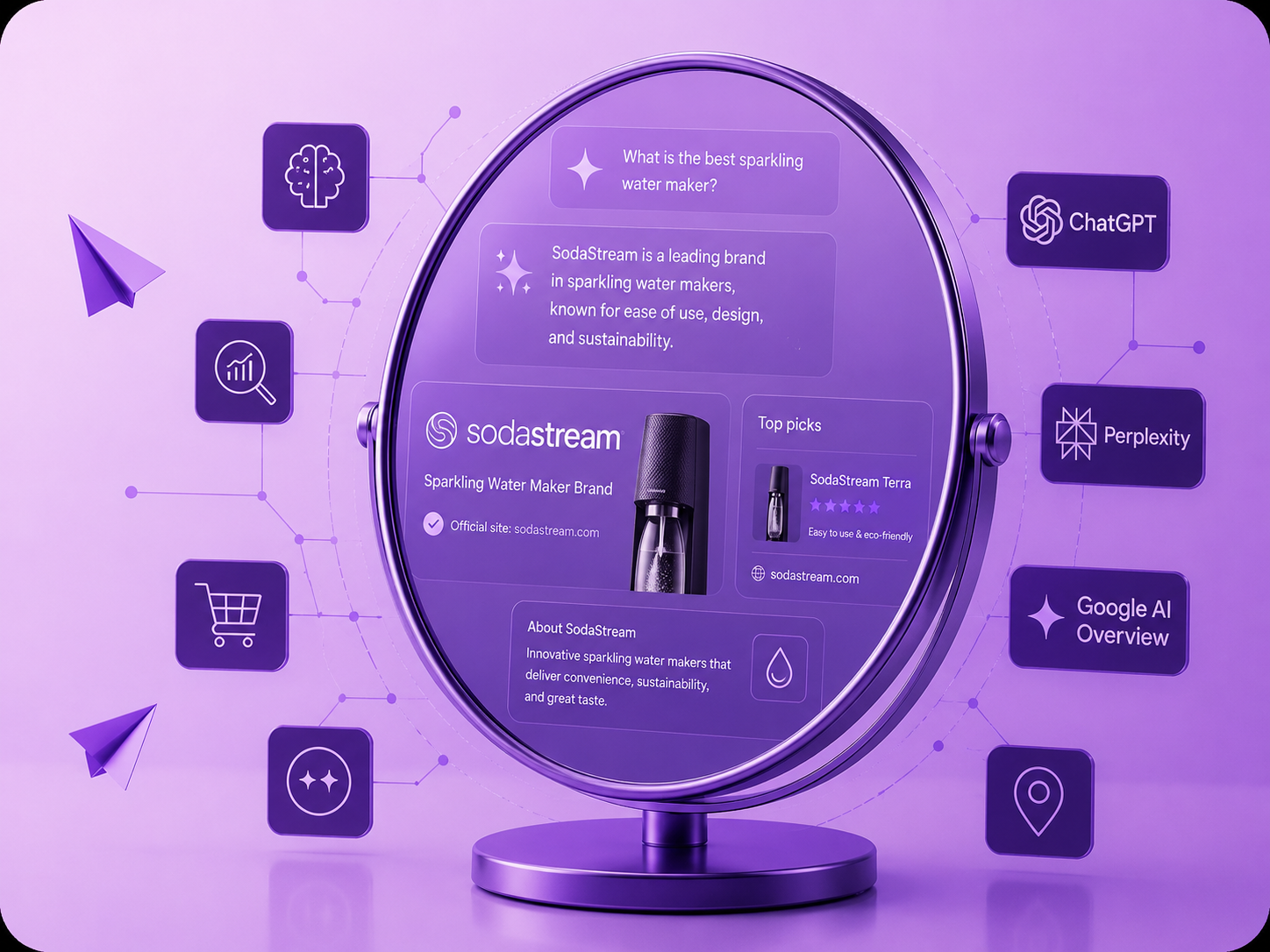
What is actually happening is that AI agents read the totality of what exists about your brand across every source: your website, your product descriptions, press coverage, third-party reviews, Reddit threads, social content, metadata. They synthesize all of it into a representation.
If that representation is consistent and rich, the output is accurate. If it is fragmented or thin, the output defaults to the safest descriptor available, which is usually a category label that applies to every competitor in your space.
That is not genericism by design. That is genericism by default. And it is fixable.
The fix starts with knowing what AI is actually saying. Research shows 85% of brand mentions in AI answers originate from third-party pages, not owned domains. That means the publications, review platforms, and community discussions where your brand appears are shaping the AI picture more than your homepage is. Most brand teams are optimizing the wrong surface.
Why AI Brand Mentions Are Now a Brand Risk
You cannot fix what you cannot see. Which is why monitoring AI brand mentions is now a core brand function, not a nice-to-have.
In traditional search, you could see your ranking, read your snippet, and know what impression you were making. AI search does not work that way. AI models synthesize a response from dozens of sources. You do not control the output. You influence the inputs.
The problem is that most brands have never looked at the output. They assume the signal is consistent because the intent was consistent. It often is not. A luxury brand gets described as a generic category player. A brand that pivoted its positioning two years ago still gets described by its old identity. These are not edge cases. They are the default when brand signal is thin, inconsistent, or fragmented.
The Four Types of AI Brand Misrepresentation
When AI gets your brand wrong, it tends to fall into one of four patterns. Knowing which one applies tells you where to focus.
Category misalignment. AI places you in the wrong tier or the wrong segment entirely. A mass-market brand described as prestige. A specialist brand lumped in with generalist competitors. This usually happens when third-party sources are using imprecise language and your own content is not specific enough to correct it.
Outdated positioning. AI is surfacing who you were, not who you are. Brands that have pivoted, expanded, or repositioned are particularly vulnerable here. Old press coverage, old product descriptions, and old review language continues to circulate long after you have moved on.
Competitor conflation. AI attributes features, claims, or characteristics to your brand that belong to a competitor, or vice versa. This happens most often in crowded categories where brand differentiation is low and the AI is pattern-matching across similar companies.
Missing identity. Your brand appears in AI outputs but with no real character. Just a descriptor. Category plus price point plus location. The brand story, the emotional territory, the reason someone would choose you over anyone else, none of it comes through. This is the most common pattern and often the hardest to fix because it is not technically wrong.
The fourth type is the one brand marketers should be most focused on. Factual errors can be corrected. A flat, generic AI representation of a brand with real depth and distinct identity is a content and signal problem that requires sustained work.
How to Run Your Own AI Brand Audit in 30 Minutes
This is the starting point. Before you can fix anything, you need to know what AI is actually saying. Here is a simple audit process you can run today.
Step 1: Define your query set (5 minutes)
Write down the five to ten questions your customers are most likely to ask an AI agent that should result in your brand being mentioned. Think in natural language, not keywords.
What is the best [category] for [specific occasion or use case]?
Who are the leading [category] brands for [audience]?
What makes [your brand name] different from [competitor]?
Is [your brand name] good for [specific need]?
What do people say about [your brand name]?
Step 2: Run the queries across three models (15 minutes)
Open ChatGPT, Perplexity, and Gemini. Run each query in all three. Do not use the same session for multiple queries as context carryover can affect results. Use incognito mode where possible.
Document what comes back. Copy the responses verbatim. Note which models mention you, which do not, and what they say when they do.
Step 3: Score what you find (10 minutes)
For each response that mentions your brand, ask four questions:
Is the category right? Are you being described as the type of brand you actually are?
Is the positioning current? Does the description reflect who you are today, not who you were two or three years ago?
Is the differentiation present? Does anything in the AI response explain why a customer would choose you specifically?
Is the brand voice there? Does the description carry any of the identity, tone, or emotional territory your brand owns?
Any no is a signal gap. Document it. That list becomes your action plan.
The Signals That Shape What AI Says About You
Once you know the gap, you need to understand where it is coming from. AI does not form its picture of your brand from your website alone.
This matters for how you prioritize fixes. If the misrepresentation is coming from an outdated press release circulating widely, a content update on your own site will not fix it. If the missing identity problem is because category-level publications only describe you in functional terms, the answer is earned coverage that goes deeper.
We have covered the content and technical side of this in more depth in The New Content Playbook for AI Visibility and Writing for AI: How to Create Content That Earns Citations. The audit tells you where the gap is. Those posts tell you how to fill it.
How to Feed AI the Right Signals Once You Know the Gap
This is where the inspiration angle becomes operational.
The brands that control their AI brand mentions are not gaming the system. They are doing what strong brand teams have always done: defining their story with precision and making sure it is expressed consistently everywhere their audience encounters them. The difference now is that AI agents are part of that audience.
Once your audit has surfaced the gaps, the fixes fall into three categories:
Owned content fixes. Update product descriptions, metadata, and brand-level pages to reflect current positioning precisely. Write content that answers the specific questions your audit identified. Use the language AI is likely to extract and cite. Be explicit about category, audience, and differentiation. Do not assume AI will infer what you mean.
Earned signal fixes. Brief your PR team on what AI is saying and what it should be saying. The goal is coverage in trusted third-party sources that reflects your current positioning in language that is specific enough to be extracted. A sentence in a publication that describes your brand correctly is more valuable for AI visibility than a paragraph on your own site.
Third-party presence fixes. Review platforms, industry directories, and comparison sites are high-weight sources for AI. Audit what they say about you. Update where you can. Flag inaccurate listings as a priority, not a backlog item.
Across all three: the standard is not just accuracy. It is the transfer of brand identity. AI should be able to read your third-party presence and understand not just what you sell, but why someone would choose you. That requires content with specificity, character, and point of view, not just correct information.
Turning the Audit Into an Ongoing Process
A one-time audit tells you where you stand today. AI outputs change as models update, as new content enters the web, and as competitors shift their own signals. The brand that runs one audit and moves on will drift.
Learn how to review brand sentiment in GeckoCheck.
The brands building durable AI visibility are treating this as a monthly discipline. A standing query set, a regular review of outputs, a clear owner who tracks change over time and flags new misrepresentation before it compounds.
That is the operational layer Geckocheck's Brand Intelligence feature is built for. It tracks how AI models represent your brand across queries and platforms, surfaces the sources shaping that representation, and shows you where the signal is strong and where it breaks down. The audit above gives you the starting point. Brand Intelligence gives you the ongoing feedback loop so you are never operating blind.
The inspiration is yours. The story is yours. Monitoring AI brand mentions is how you make sure AI is telling it right.