ChatGPT now runs ads. The platform launched sponsored placements in February 2026, and it changed the visibility equation for every brand operating in AI search. But paid placement is only one layer. Organic mentions still drive the majority of brand appearances inside ChatGPT, and the signals that determine them are very different from what you're used to in Google. Here's how both work.
1. What Are ChatGPT Ads
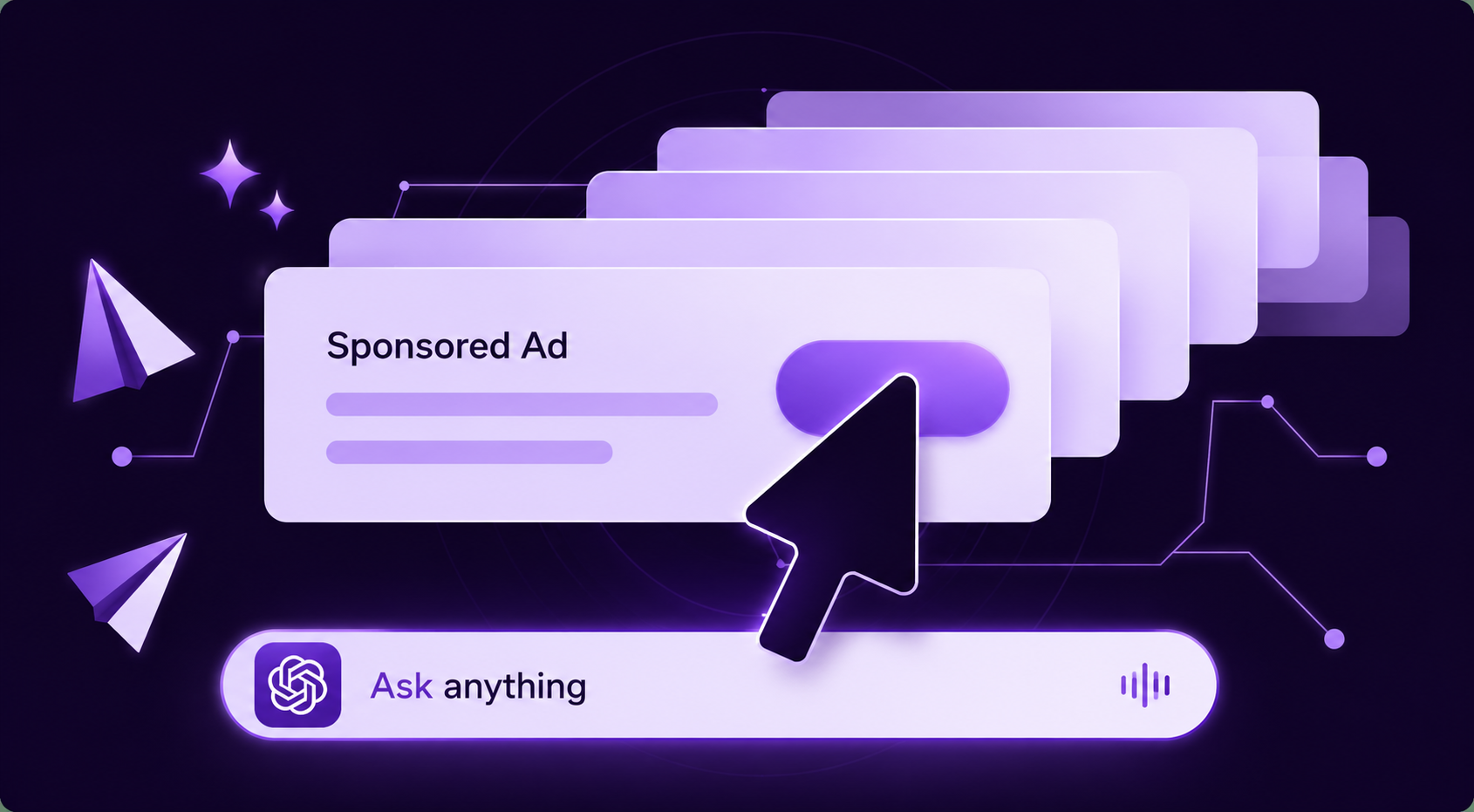
ChatGPT ads are sponsored placements that appear inside AI-generated responses. They launched on February 9, 2026 for U.S. users on the Free and ChatGPT Go tiers. Paying subscribers on Plus, Team, and Enterprise remain ad-free.
The format is contextual. Ads appear as clearly labeled, subtly tinted boxes below the AI's answer. OpenAI has been explicit: ad placements do not influence the content of the response itself. The answer is generated independently of which brands are advertising.
Targeting runs on conversation context, not on behavioral tracking profiles. The platform matches ads based on the current query topic, general location, and language. That's a meaningful departure from how Google and Meta operate.
Ad formats currently running
Sponsored conversation modules below AI responses
SearchGPT sponsored results for web-search-mode queries
Product card modules for commercial and shopping intent queries
2. How OpenAI Is Approaching Advertising and Monetization
The transition from no-ads to ad-supported happened quickly. OpenAI moved from a limited beta requiring $200,000 minimum commitments to a fully self-serve platform, OpenAI Ads Manager, accessible to any advertiser. CPC and CPM bidding are both available, with no stated minimum spend as of May 2026.
CPM pricing has been reported at around $60, significantly above typical display advertising. That's OpenAI's signal that it sees ChatGPT as a premium brand environment, closer to a sponsorship buy than a performance channel.
Major holding companies including Dentsu, Omnicom, Publicis, and WPP are already integrated. Technology partners include Adobe, Criteo, Kargo, Pacvue, and StackAdapt. On June 17, 2026, OpenAI published new Ad Tools Terms introducing two additional advertiser features: Audience Tools for first-party data upload and Creative Tools for AI-generated ad creative. Both are policy-announced and not yet confirmed live in the Ads Manager.
What this means for the channel
Organic and paid visibility now co-exist in the same interface, as separate layers
A brand can appear in the sponsored module, in the organic response, or in both
OpenAI states the two layers don't influence each other, though the mechanics behind the scenes aren't fully disclosed
3. How ChatGPT Decides Which Brands to Mention Organically
This is where most brands are underinvesting. Paid ads account for a fraction of brand appearances inside ChatGPT. The majority happen through organic mentions in the AI-generated answer, and those mentions are driven by a different set of factors than ad spend.
BrightEdge's analysis of tens of thousands of ChatGPT prompts found the platform mentions brands 3.2x more often than it formally cites them. Most brand visibility inside ChatGPT is still zero-click. The brand name appears, the user reads it, no link is followed. That changed meaningfully on May 7, 2026, when ChatGPT began embedding live brand links in responses. Within one week, referral traffic from ChatGPT to monitored brand websites increased by over 150% week-over-week.
The signals that drive organic mentions
Off-site trust footprint: media coverage, analyst citations, reviews on G2 or TrustRadius, directory listings, community mentions on Reddit and YouTube. Ahrefs' December 2025 study found branded web mentions were the strongest predictor of AI visibility, at a 0.664 correlation with AI Overview appearances.
Entity clarity: ChatGPT needs a consistent association between your brand name, what you do, and who you serve, across your site and across third-party sources. Inconsistent positioning fragments that signal.
Content structure: pages written in clear, extractable formats, direct answers, comparison tables, FAQ sections, are cited at higher rates than long-form prose.
Source authority: a single placement in Search Engine Journal or TechCrunch has more weight on AI citation than dozens of self-published posts.
4. How to Position Your Brand for Visibility Inside ChatGPT Today
There are two distinct tracks. Paid gives you a placement in the sponsored module, subject to targeting and budget. Organic requires building the kind of trust footprint ChatGPT draws from when it generates its answer.
On the paid side
Access via OpenAI Ads Manager, now fully self-serve
CPC and CPM available; test with a defined budget before scaling
Targeting is contextual, so ad creative should match query intent precisely
Measurement is currently basic: impressions and clicks, with conversion attribution still limited
On the organic side
Audit your current AI visibility: run your category queries directly in ChatGPT and note whether your brand appears, how it's characterized, and who ranks alongside you
Build your off-site footprint: prioritize third-party mentions, press coverage, review sites, and community presence over adding more owned content
Pitch the comparison and roundup articles ChatGPT already cites: identify which pieces ChatGPT references for your category and get your brand included
Structure owned content for AI extraction: front-loaded value, clear headings, FAQ sections, and schema markup
Maintain content freshness: ChatGPT weights recency; a 90-day refresh cadence on your highest-value pages is a practical floor
5. How Geckocheck Tracks Your Brand Visibility Inside ChatGPT
Most brands don't know whether they're appearing in ChatGPT responses for their category queries. And when they do appear, they don't know how they're being characterized. Geckocheck tracks both.
The platform monitors your brand mentions, citations, and sentiment across ChatGPT and other AI search engines. You can see which category prompts surface your brand, which surface competitors, and what language the model uses when it describes you. If ChatGPT is reducing your brand to a flat category descriptor rather than surfacing what actually differentiates you, that shows up in the data.
With paid placements and organic mentions now operating side by side, measuring both layers in the same view matters. If you want broader context on how the shift to LLM advertising is playing out across ChatGPT, Gemini, and Claude, our guide to the next era of digital advertising covers the full picture. Geckocheck's AI visibility monitoring gives you that view across both paid and organic surfaces.
Want to turn this into a practical visibility strategy? Explore GeckoCheck’s ChatGPT ads tracking and competitor insights to understand sponsored placements alongside your organic AI presence.
6. FAQs
Do ChatGPT ads affect which brands the AI recommends organically?
Based on current public information, no. Sponsored placements appear in designated modules below the AI's answer, and OpenAI states that ad purchases don't influence response content. The two layers appear to operate independently, though what happens behind the scenes is not fully documented.
Who sees ChatGPT ads?
Ads are shown to users on the Free and ChatGPT Go tiers. Plus, Team, and Enterprise subscribers don't see ads.
How do I advertise on ChatGPT?
Through the OpenAI Ads Manager, which moved to full self-serve access in early 2026. No minimum spend is currently required. You can reach it at openai.com/advertisers.
How do I get my brand mentioned in ChatGPT organically?
Build your off-site trust footprint: media coverage, third-party reviews, analyst citations, and community mentions. Define your entity clearly across all content. Structure pages for AI extraction. Organic visibility is earned, not bought. Ad spend doesn't influence it.
How can I track whether my brand is appearing in ChatGPT?
Run category prompts manually in ChatGPT and record what surfaces. For systematic tracking across multiple queries and AI platforms, Geckocheck monitors brand mentions, citations, and sentiment in AI search automatically.