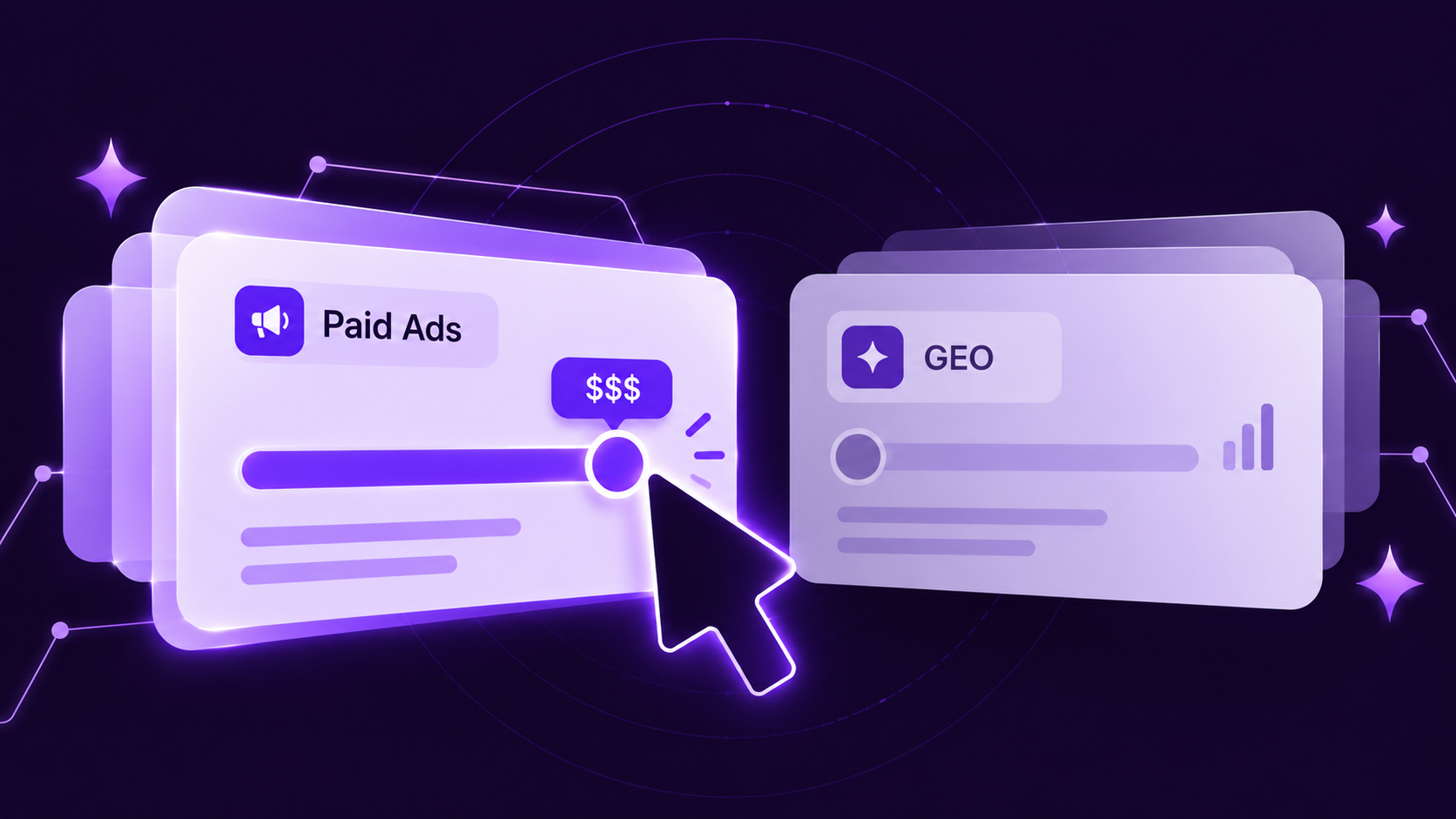
This year, three of the biggest LLM platforms made three very different decisions about advertising. OpenAI launched ads in ChatGPT. Google built sponsored formats into Gemini's AI Mode. Anthropic said Claude would stay ad-free. For brands trying to understand where their visibility comes from in AI search, those decisions matter. They change what showing up actually means, depending on which platform someone is using.
Key Takeaways
Has LLM advertising actually launched, or is it still theoretical?
It is live. ChatGPT ads reached a full rollout in February 2026, and Gemini-powered sponsored formats followed in May.
Is Claude part of the LLM ads rollout?
No. Anthropic committed to keeping Claude ad-free in February 2026, the opposite choice from OpenAI and Google.
Do ads in LLMs change the answer a model gives?
Both OpenAI and Google say sponsored content is labeled and generated separately from the underlying response, though that separation is still being tested at scale.
How big could LLM ad spend get?
eMarketer projects US AI search ad spend will climb from $2.08 billion in 2026 to $25.93 billion by 2029.
What should brands do to prepare for ads in LLM search?
Track organic citations and sponsored eligibility together across ChatGPT, Gemini, and Claude, since the same signals increasingly affect both.
Three platforms, three different decisions
This year, three of the largest LLM providers made three different calls on advertising within months of each other. In February 2026, OpenAI began testing ads in ChatGPT for logged-in adult users on the Free and Go tiers, then opened a self-serve Ads Manager to all US businesses by May. That same month, Google introduced Gemini-powered ad formats inside AI Mode at Google Marketing Live. Anthropic announced early on that Claude would stay ad-free.
The scale of the opportunity helps explain the timing. eMarketer's forecast puts US spending on AI search ads at $2.08 billion in 2026, about 1.3 percent of total search ad budgets, rising to $25.93 billion by 2029, roughly 13.6 percent of the category. That growth curve is steep enough that the decisions platforms make now will likely shape the category for years.
ChatGPT (OpenAI): live and self-serve, with “Sponsored” placements shown to Free and Go tier users
Gemini / AI Mode (Google): in testing, with AI-generated sponsored formats inside search and shopping results
Claude (Anthropic): no ads of any kind, by policy, since February 2026
ChatGPT, Gemini, and Claude: how each handles it
The differences go beyond whether ads exist at all. Each platform is monetizing AI search in a way that fits its existing business model.
Platform | Ad Status | How It Works | Who Sees Ads |
|---|---|---|---|
ChatGPT (OpenAI) | Live since February 2026. Self-serve since May 2026. | A “Sponsored” label appears below the response, matched to the live conversation topic and chat history. | Free and Go tier US users. Plus, Pro, Business, Enterprise and Edu stay ad-free. |
Gemini / AI Mode (Google) | In testing since May 2026. | Conversational Discovery Ads and Highlighted Answers, written by Gemini, with an independent AI explainer alongside the advertiser's creative. | US users testing AI Mode on mobile and desktop. |
Claude (Anthropic) | Ruled out in February 2026. | No sponsored placements of any kind. | All users. |
For OpenAI, advertising extends the free tier the way display ads have long subsidized free software elsewhere. For Google, it extends an advertising business that already exists into a new surface. Anthropic framed staying ad-free as a deliberate choice in a public statement, pointing to a business mix weighted toward subscriptions and enterprise contracts as part of why the company does not need advertising revenue from its free tier.
Where ads actually show up in an AI conversation
Across ChatGPT and Gemini, sponsored content is showing up in a handful of distinct formats, each tied to a different kind of query.
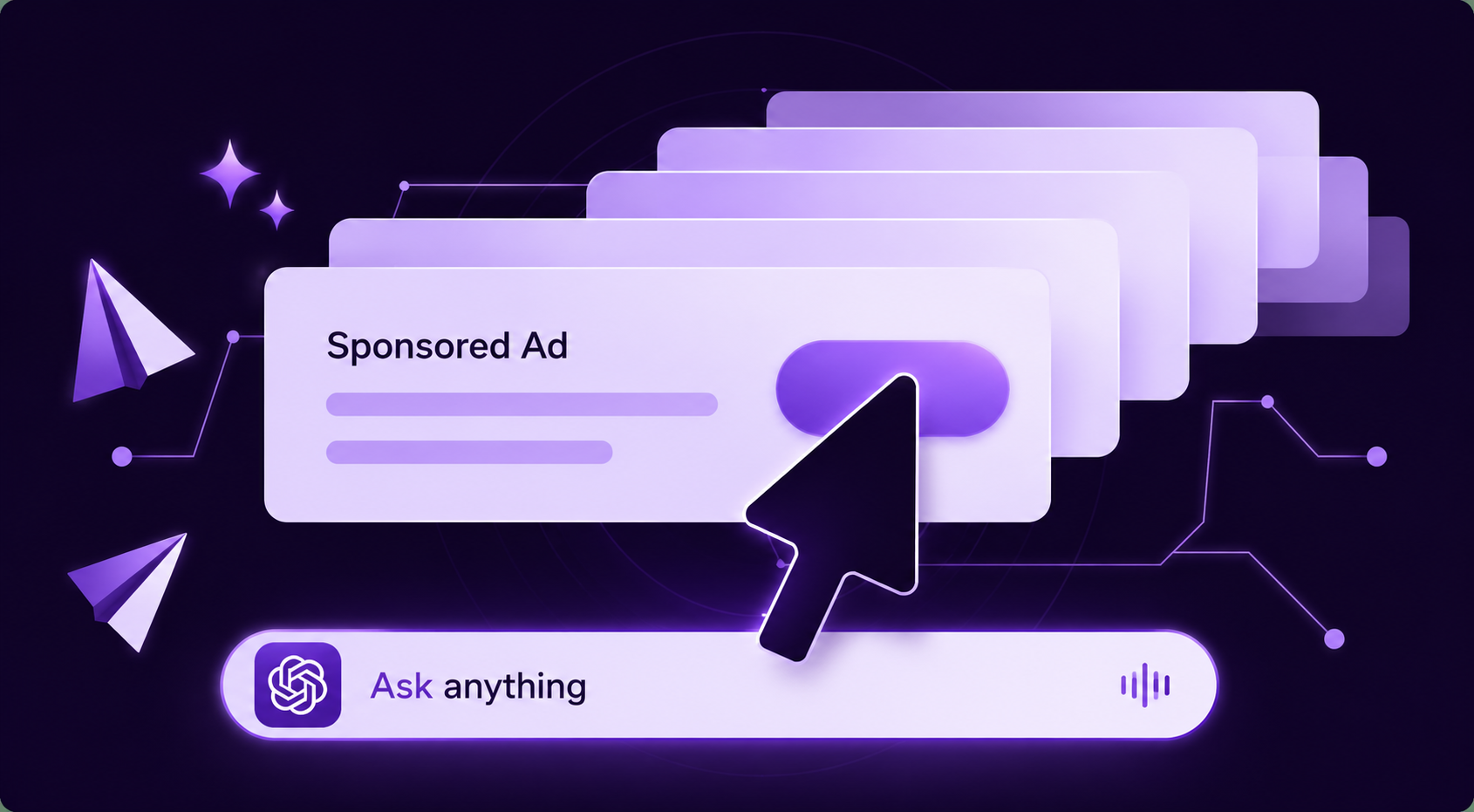
Sponsored answer box: a labeled block below ChatGPT's response, kept visually separate from the generated answer itself
Conversational Discovery ads: Gemini writes ad creative in direct response to a specific question, such as low-maintenance ways to make a home smell better
Highlighted Answers: a sponsored option placed inside a list-style recommendation alongside organic suggestions, for example when AI Mode is asked for the best language-learning apps
AI Shopping ads and Direct Offers: product cards with pricing, availability, and in some cases checkout, aimed at considered purchases
App and action campaigns: surfaced when a query maps to a task an app or service can complete directly
None of this applies to Claude. There is no sponsored box, no AI-generated ad creative, and no shopping unit, because there is no advertising layer to place them in.
Why organic and paid are running on the same signals
The selection logic is where ads and organic visibility start to overlap. OpenAI has said ChatGPT's ad matching uses a contextual retrieval engine tied to the live conversation rather than historical behavioral tracking. Google has gone further, detailing how Highlighted Answers cannot simply be bought into. Relevance and content quality determine eligibility, even in a paid slot.
Both platforms also generate an independent explainer alongside the ad. Google describes this as a Gemini-written summary of the product, produced separately from whatever the advertiser submitted. The model forms its own view of a brand even inside a sponsored placement, drawing on the same kind of source material that shapes organic citations.
That overlap matters practically. The structured, accurate product information that earns a citation in an organic answer is increasingly the same information that determines whether a brand qualifies for a paid slot. The two channels are being built on the same foundation.
Why context is starting to matter more than keywords
Ad matching in LLMs is also becoming more session-aware. ChatGPT's targeting draws on the current conversation topic, prior chat history, and previous ad interactions, not only the immediate query. Google has a similar direction with Personal Intelligence, a personalization layer currently in beta for AI Pro and AI Ultra subscribers.
What this means in practice: two people asking the same question may see different sponsored results depending on what each has discussed with the model before. Tracking whether a brand appears for one query, at one moment, is becoming a less complete picture. The question is how a brand performs across contexts, not just keywords.
What's still unresolved
Both OpenAI and Google built guardrails into their initial rollouts. Ads are excluded for now from sensitive categories such as health, dating, financial services, and politics, and both companies state that sponsored content does not influence the model's underlying answer. Neither claim is something brands can independently verify yet.
Whether a product or category even qualifies for a sponsored placement, given the current exclusions
How much a sponsored result can vary by user, if targeting depends on conversation history rather than a single query
Whether the separation between ads and answers holds up at scale, since it is currently a platform claim rather than an audited outcome
How a brand with no paid lever at all, such as on Claude, is performing in organic citations alone
These are early days. The rules for ChatGPT and Gemini's ad formats are likely to keep changing as both move out of testing and toward broader release.
How Geckocheck tracks the full picture
The result is a visibility picture that now differs by platform. On ChatGPT and Gemini, a brand can appear in an AI answer organically, through a sponsored placement, or both. On Claude, there is only one way in: the organic citation.
Geckocheck tracks how brands show up across ChatGPT, Claude, Gemini, and other AI search tools, covering both the organic mentions that drive most LLM visibility today and the sponsored formats rolling out alongside them. Our AI visibility platform shows where you appear and where you don't, across every major AI search surface.
As ad formats roll out unevenly across platforms, the brands with the clearest picture will be the ones tracking organic and sponsored visibility together. That's what Geckocheck is built for.
For a closer look at the paid side of AI discovery, explore GeckoCheck’s AI advertising visibility tools for tracking placements, competitor activity, and high-intent opportunities.