Something changed in how people find brands, and it happened faster than most marketing teams noticed. Customers who used to type a query into Google and click a link are now asking ChatGPT for a recommendation and taking the answer at face value. They are asking Perplexity which product is worth buying. They are reading what Google AI Overviews surfaces before they ever scroll to organic results.
AI search referral traffic grew 357% year over year in 2025, according to Similarweb. That is not a trend to watch. It is a channel that already moved while most marketing teams were still measuring the old one.
That is what AI visibility platforms were built to solve. They track what shows up in AI-generated answers, which brands get cited, and what is driving those citations. This guide covers the seven worth your attention in 2026. We start with GeckoCheck, which we built, then cover the rest plainly.
What Is AI Visibility Platform
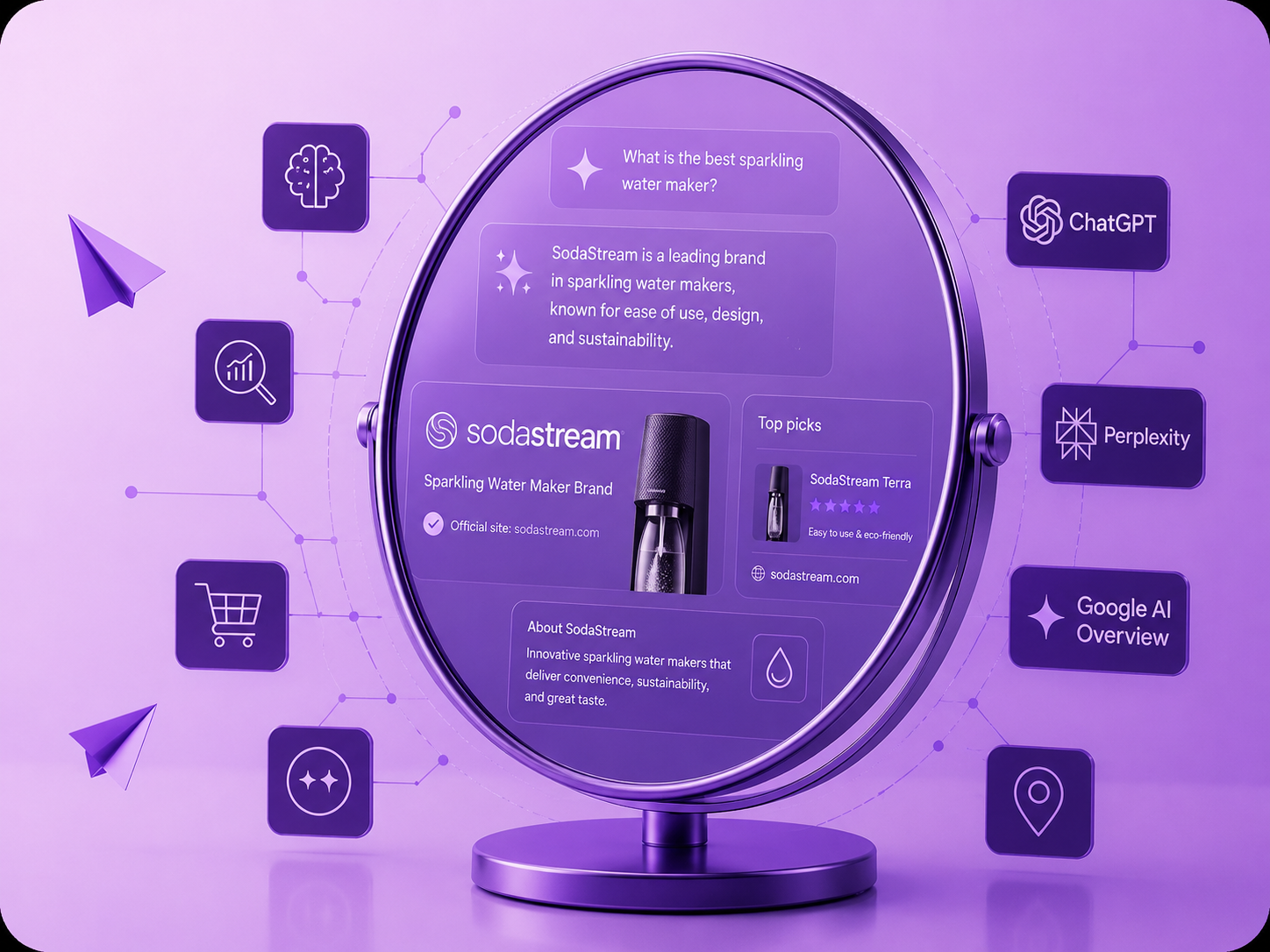
The AI visibility platform monitors how your brand shows up when someone asks ChatGPT, Claude, Perplexity, or Google Gemini a question. When a potential customer asks an AI platform what the best option is in your category, you want to know if your brand gets mentioned and whether what it says is accurate.
Traditional SEO tracking does not cover this. Google Analytics cannot tell you what ChatGPT said about your company or whether Perplexity recommended you to someone comparing options in your category. The two channels measure fundamentally different things.
These tools work by running queries across multiple AI platforms and analyzing the responses for brand mentions, citation sources, and how your brand is framed. Share of AI voice measures how often your brand appears compared to competitors when people ask questions in your category. Most brands have never measured it.
One thing worth understanding before you pick a tool: AI platforms can and do mention brands incorrectly. They sometimes attribute features that do not exist or cite outdated information. This is called hallucination. A tool that only counts mentions without flagging accuracy issues is telling you half the story.
How to Choose the Right AI Visibility Platform
Start with the question of what you actually need. Some tools count how many times your brand appears in AI responses. Others show you what the AI said, which sources it cited, and whether the information was accurate. Those are different tools for solving different problems.
Multi-platform coverage matters more than most teams realize. ChatGPT is one slice of AI search. Customers are also using Claude, Perplexity, Google Gemini, and AI Overviews. A tool that only monitors one or two platforms gives you a partial picture.
The most important distinction is whether the tool was built for AI search from the start or whether AI features were added onto an existing SEO platform. Purpose-built AI visibility tools go deeper on the data that drives GEO decisions: citation sources, share of voice by prompt type, competitor presence at the answer level.
Look for these capabilities when evaluating any AI visibility tool:
Citation source tracking: which URLs the AI is pulling from when it mentions your brand
Competitor share of voice: how your brand visibility compares to direct competitors across the same prompts
Sentiment context: whether the AI is framing your brand positively, neutrally, or negatively
Prompt-level data: visibility broken down by the specific questions driving AI answers in your category
Competitive gap data: where competitors are winning visibility that you are not
1. GeckoCheck: The AI Visibility Tool Built for Brands and Commerce
GeckoCheck was built to answer one question every brand should be asking but most cannot: when someone asks an AI platform about my category, do I show up and how?
Most AI visibility tools started as traditional SEO platforms and added AI tracking as an afterthought. GeckoCheck started with AI search. The entire platform is designed around how generative engines discover, evaluate, and cite brands rather than around how Google crawls pages. That difference shapes everything from how data is collected to what actions the platform surfaces.
What GeckoCheck Tracks
GeckoCheck monitors brand visibility across the four AI platforms that account for the overwhelming majority of AI-driven discovery: ChatGPT, Perplexity, Google AI Overviews, and Gemini. For each platform, the dashboard shows whether your brand appears in AI-generated answers for your target prompts, your share of voice versus direct competitors in those answers, the specific sources and citations AI engines are using to form their responses, which prompts trigger brand mentions and which leave you out entirely, and how your brand visibility trends over time as you make changes.
Why GeckoCheck Is Different
The core distinction is focus. Every decision in the product, what to track, how to display it, what to surface in the dashboard, is made through the lens of brand and commerce teams running GEO programs. Not enterprise SEO teams managing hundreds of domains. Not agencies running link audits. Brands that need to know whether AI is recommending them.
GeckoCheck is the only AI visibility intelligence platform built specifically for merchants and brands. Where other tools bolt AI tracking onto existing SEO infrastructure, GeckoCheck was engineered from the ground up to track, measure, and improve how brands appear in AI-generated answers.
That focus produces a cleaner product. There is no bloat from legacy SEO features. No credit systems that force you to choose which AI engines to track. No dashboard noise from rank tracking data that has nothing to do with conversational AI. The platform shows you exactly what is happening to your brand visibility in AI search and nothing else.
The AI Visibility Intelligence Layer
Beyond tracking whether you appear, GeckoCheck surfaces the intelligence behind it. Which competitors are consistently being cited alongside you or instead of you. Which specific URLs are being used as citation sources by AI engines. What the AI is actually saying about your brand when it does mention you, and whether that framing is accurate.
This is what turns AI visibility data into something actionable. Knowing you appear in 40% of relevant prompts on ChatGPT is useful. Knowing exactly which sources your competitor uses to appear in 70% and seeing that gap clearly is what drives a real content strategy.
Built for Commerce
GeckoCheck has a specific focus on merchants and commerce brands, the category where AI-driven product discovery is moving fastest. When a shopper asks Perplexity which running shoe to buy or ChatGPT which skincare brand to trust, the AI generates a recommendation. GeckoCheck is built to track whether your brand is in that recommendation, what is driving it, and how to close the gap when it is not.
Rather than showing domain authority or keyword overlap, GeckoCheck surfaces the competitive visibility metrics that actually matter in AI search: share of voice by prompt category, citation frequency versus competitors, and which content assets are driving AI mentions across engines.
Key Features
Multi-engine AI visibility tracking across ChatGPT, Perplexity, Gemini, and Google AI Overviews
Share of voice benchmarking against direct competitors by prompt category
Citation source intelligence showing exact URLs and sources driving AI mentions
Prompt-level visibility breakdown so you can see which questions trigger your brand
AI visibility trend tracking over time
Clean dashboard built for brand and commerce teams, no legacy SEO noise
2. Profound
Profound is a dedicated AI visibility platform built for enterprise teams. It tracks brand mentions and citations across ChatGPT, Perplexity, Google AI Overviews, and other major AI engines, and layers in sentiment analysis and source attribution so teams can see not just whether their brand appears, but how it is framed. Their Conversation Explorer surfaces AI search topic volume data that shows which questions in your category are driving the most activity. G2 named it a Winter 2026 Leader in the AEO category.
Profound operates on what they call a read/write model: track where you stand, then use their built-in content tools to close the gap. In practice this means the platform goes deeper on data than most tools, including keyword-level prominence scoring and reverse-engineered source attribution that traces AI responses back to specific content on your site. The trade-off is complexity. Getting real value from Profound requires a team that can interpret granular analytics and act on them. It is not a quick-start platform, and it was not designed to be one.
Features
Brand tracking across multiple AI engines
Content generation tools for visibility gaps
AI search topic volume data
Enterprise security and compliance
Analytics for Shopify and WordPress integrations
Best for: Large enterprise teams.
3. Peec AI
Peec AI tracks brand visibility across ChatGPT, Perplexity, Gemini, and AI Overviews on a daily basis. The platform runs checks through browser sessions that simulate real user interactions, which means the results reflect what an actual person would see rather than what an API returns under test conditions. Clients include Chanel, Axel Springer, and ElevenLabs.
Peec is designed to reduce complexity rather than add to it. The reporting surfaces the most actionable trends without requiring analysts to dig through raw data. Their smart prioritization ranks visibility opportunities by potential impact, so teams know where to spend their time. The platform supports 115+ languages, making it viable for brands with significant non-English markets. Unlimited team seats on all plans is a meaningful structural advantage for agencies managing multiple clients.
Features
Daily tracking across ChatGPT, Perplexity, Gemini, and AI Overviews
Browser-session based data collection
115+ language support
Unlimited seats on all plans
Looker Studio connector
Best for: Mid-market teams and agencies.
4. Ahrefs Brand Radar
Ahrefs Brand Radar extends the Ahrefs SEO platform into AI visibility tracking. Its prompt library is drawn from 260 million real search queries rather than synthetically generated questions, which means prompts reflect how people actually phrase things. Coverage spans ChatGPT, Perplexity, Gemini, Google AI Overviews, AI Mode, and Copilot. Brand Radar also retains historical data, giving teams a longer trend window than most standalone GEO tools offer. Custom prompt tracking lets teams go beyond the default library to monitor specific questions most relevant to their category.
The cost structure is layered: each AI platform index is a separate add-on on top of the standard Ahrefs subscription, and accessing all six engines adds meaningful cost to the base plan. The platform also operates on scheduled snapshots rather than live queries, which creates a lag between what AI engines are currently saying and what the dashboard shows. For teams already invested in Ahrefs for traditional SEO, the consolidation may be worthwhile. For teams starting a GEO program fresh, the total cost and snapshot methodology are worth evaluating against purpose-built alternatives.
Features
Brand monitoring across 6 AI platform indexes
260 million search-backed prompts
Custom prompt tracking available
Historical visibility data
YouTube, TikTok, and Reddit mention tracking
Best for: Existing Ahrefs subscribers.
5. Yext Scout
Yext Scout is built into the Yext platform and approaches AI visibility from a local and multi-location angle that no other tool on this list addresses. It generates a proprietary Visibility Score combining AI and traditional search performance, then benchmarks each location against nearby competitors within roughly a two-mile radius. Scout monitors visibility across ChatGPT, Gemini, Grok, and Perplexity alongside Google, and its recommended actions feed directly into Yext Listings, Reviews, and Pages, so insights can be acted on without leaving the platform.
The platform is built for multi-location operators where the question is not just am I visible nationally, but why is this location underperforming compared to the one nearby. For retail, hospitality, healthcare, and QSR brands, that hyper-local lens is genuinely valuable and difficult to get anywhere else. The platform is only accessible as part of a Yext subscription, which means it is off the table for teams not already in that ecosystem. For brands without physical locations or those building a GEO program outside of Yext, a standalone AI visibility tracker will be a more direct fit.
Features
AI and traditional search visibility scoring
Location-level competitive benchmarking
Recommended actions tied to Yext platform
200+ publisher integrations
Best for: Multi-location brands already on the Yext platform.
6. Yotpo
Yotpo is a reviews and user-generated content platform. It collects verified reviews, Q&As, and customer photos, then syndicates that content across Google, TikTok, and major retail partners including Target. It does not track AI visibility and has no dashboard that shows how your brand appears in ChatGPT or Perplexity.
It is relevant here because AI engines using Retrieval-Augmented Generation pull from verified third-party sources to ground their recommendations. Customer reviews are exactly that kind of source. An AI recommending a product is not synthesizing your product page copy. It is reading what real customers said about it. Q&As published through Yotpo also mirror the conversational phrasing of actual AI queries, which increases the likelihood that your content gets surfaced as a citation. The caveat: Yotpo creates the signals. To know whether those signals are actually moving your AI visibility, you need a separate tracker like GeckoCheck to close the measurement loop.
Features
Review collection and syndication
Q&A content publishing
Distribution to Google, TikTok, and Target
GTIN-compliant structured product data
Best for: Ecommerce brands building review content as a GEO signal.
7. Semrush AI Toolkit
Semrush has integrated AI visibility tracking into its existing SEO platform. The AI Toolkit monitors brand citations across ChatGPT, Google AI Overviews, AI Mode, Gemini, Perplexity, Grok, Mistral, and Claude, making it one of the wider coverage sets available through a traditional SEO platform. It includes an AI Visibility Score that functions similarly to domain authority, giving teams a single number to benchmark against competitors. The site audit component flags technical issues that affect how AI crawlers access and interpret your content, which is a layer most GEO-only tools skip entirely.
The practical limitation is that Semrush is a traditional SEO platform first. The AI features are built on top of that foundation, and the seams show. Prompt tracking is currently US-only. The interface and data model are organized around keywords and rankings rather than the conversational prompt structure that matters in AI search. For teams already deep in the Semrush ecosystem, adding AI visibility tracking without switching platforms is a reasonable move. For teams building a GEO program from scratch, starting with a platform designed around AI search from the beginning will produce better results faster.
Features
Citation tracking across 8 AI engines
AI Visibility Score
AI-specific site audit
Share-of-voice reporting
Free AIO Visibility Checker tool
Best for: Existing Semrush users wanting basic AI visibility data without a new platform.
How to Choose
The right AI visibility platform depends on what your team actually needs. The most important question is whether the tool was built for AI search from the start or added AI features onto a traditional SEO product. Those are not the same thing and they produce meaningfully different results.
If you are a brand or commerce team that needs to know where you stand in AI-generated answers and what is driving your competitors' visibility, GeckoCheck was built for exactly that. Visit geckocheck.com to get started.