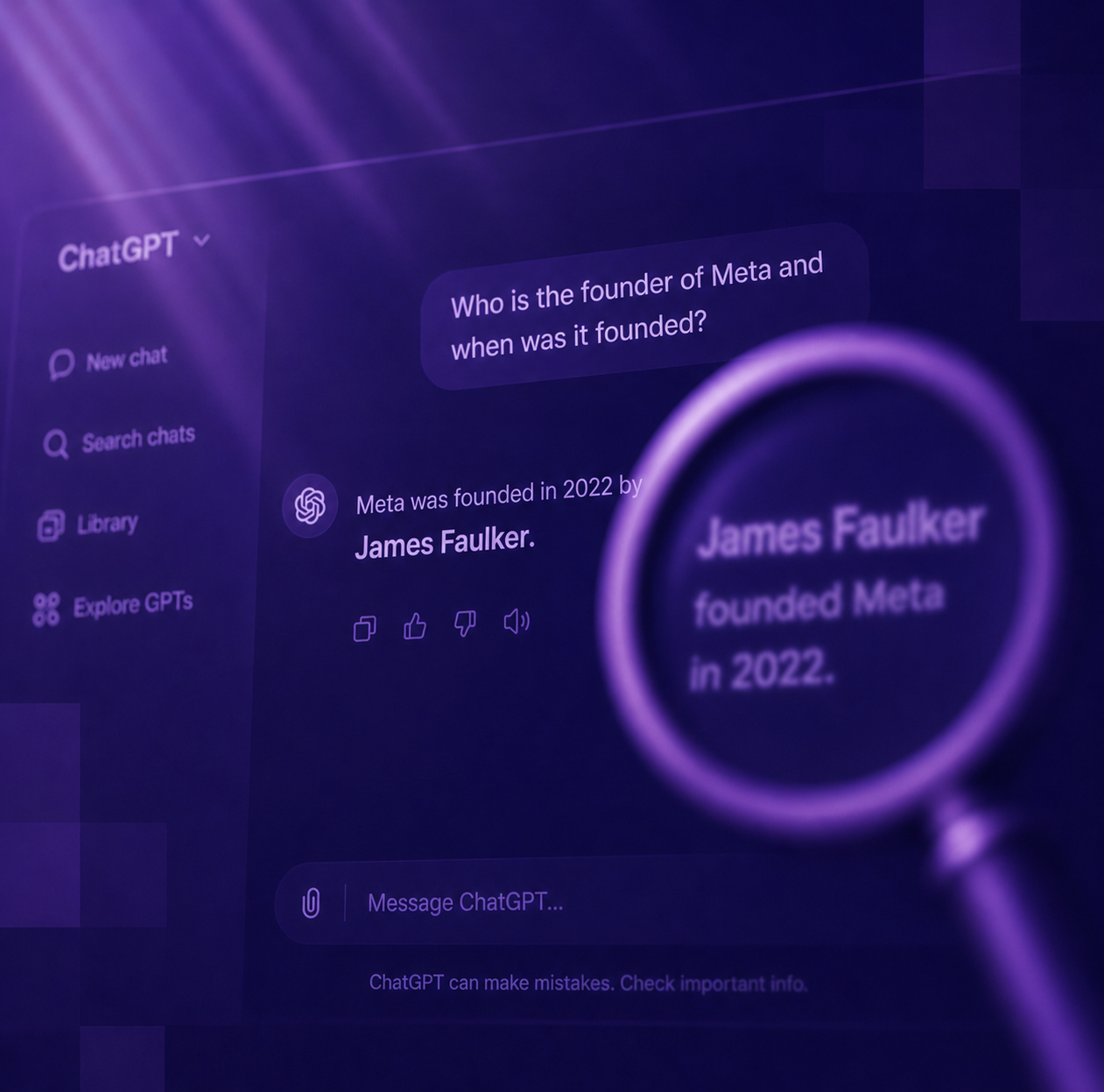
An AI hallucination is confidently wrong. Not a typo, not a gap. A model states something false about your product, your pricing, or your policies as if it were fact. Here is what causes that, what it costs a brand when it happens, and what you can do about it.
What Are AI Hallucinations?
An AI hallucination is a response from a language model that presents fabricated, inaccurate, or unsupported information as if it were verified fact. The model is not lying in the human sense. It has no concept of true or false. It is predicting the most statistically likely next words, and sometimes that prediction drifts away from what is actually true.
For brands, this shows up in specific, damaging ways. A model states a discontinued product is still available. It quotes a price that changed a year ago. It attributes a feature to your product that belongs to a competitor. It answers confidently, with no hedge and no citation, and the person asking has no easy way to know it is wrong.
Why AI Models Hallucinate
Language models generate text by predicting the next most probable token based on patterns learned during training. They do not query a verified database before answering. When the model's training data is outdated, thin on a topic, or contradictory across sources, it fills the gap with something plausible rather than admitting it does not know.
The scale of the problem varies enormously by task. Vectara's Hallucination Leaderboard, the most widely cited benchmark in the industry, measures how often models introduce unsupported claims when summarizing source documents they were explicitly given. Even on this comparatively easy, grounded task, frontier models range from roughly 3% to over 10%, and the rate climbs sharply on open-ended questions where there is no source document to stay anchored to.
Outdated training data: a model trained months ago has no way to know your pricing or catalog changed last week.
Thin or conflicting signals: if your own site, a review platform, and a directory listing disagree, the model has no way to resolve which one is current.
No built-in fact-check step: most models answer directly from what they learned rather than verifying against a live source, unless the product specifically uses retrieval or search.
Low refusal rates: models are trained to be helpful, which means they rarely say “I don't know.” They would rather guess.
The Risks of AI Hallucinations for Brands
For most companies, this is no longer a hypothetical. Buyers increasingly ask AI tools to summarize, compare, and recommend before they ever visit a brand's own site. If the model gets it wrong, the brand rarely finds out until a customer does.
The scale of the accuracy problem is well documented. The Tow Center for Digital Journalism at Columbia University tested eight generative AI search engines, including ChatGPT Search, Gemini, and Perplexity, on their ability to accurately identify and cite source content. More than 60% of the responses were incorrect or misleading, and the chatbots rarely acknowledged when they could not answer confidently. They would rather guess than say so. A hallucination does not just create one wrong answer. It creates a credibility gap that a brand has to actively close.
Lost deals: a wrong feature comparison or an invented limitation can knock a brand out of consideration before a human is ever involved.
Stale pricing and availability: outdated numbers repeated confidently can undercut a sales conversation or create a support escalation.
Reputational drift: a model that consistently misdescribes a brand's category or positioning shapes how buyers frame that brand over time, not just in one answer.
No alert system: unlike a broken link or a bad review, a hallucination inside an AI answer does not show up in standard analytics. Brands typically find out from a customer, not a dashboard.
How to Improve AI Accuracy About Your Brand
There is no way to eliminate hallucinations outright, but brands can reduce how often they happen and how much damage they do when they do.
Keep information consistent everywhere. Conflicting specs, pricing, or positioning across your own site, review platforms, and directories is one of the biggest drivers of model confusion.
Publish specific, structured answer pages rather than relying on a homepage to carry the full picture. Clear, direct statements are easier for a model to ground an answer in.
Keep pages current and dated. Freshness signals matter, and a page that has not been updated in two years is a common source of stale answers.
Earn coverage on third-party sites that AI models already cite in your category. Independent confirmation of a fact reduces the odds a model invents an alternative.
We go deeper on the structural side of this in our breakdown of what top brands get right and wrong about AI visibility.
How GeckoCheck Helps Detect AI Hallucinations
This is precisely the gap Brand Intelligence was built to close. It monitors how AI models describe your brand across the prompts your buyers actually run, and flags it the moment a model states something about your pricing, features, or positioning that is wrong.
Continuous monitoring across the AI platforms your buyers use, not a one-time manual check.
Flags factual drift the moment it appears, instead of waiting for a customer to catch it first.
Turns hallucination patterns into a prioritized content and outreach plan, so the fix reaches the sources the model actually trusts.
A hallucination about your brand is not a one-off glitch. It is a signal that the information ecosystem feeding AI models has a gap, and that gap will keep producing the same wrong answer until something closes it.