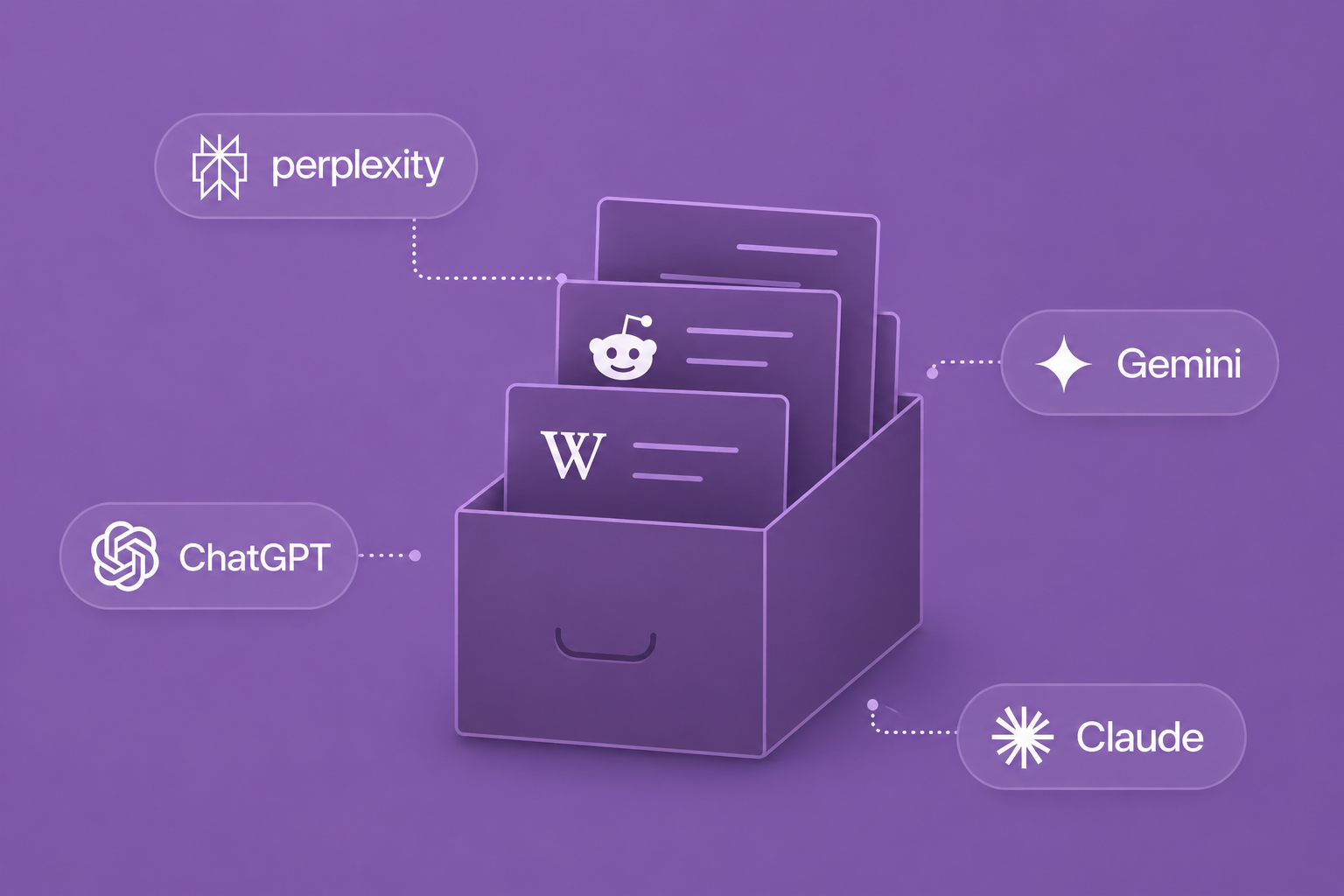
How AI Search Engines Choose Sources and Citations
Most marketers still treat AI search as one system making one decision. It is not. ChatGPT, Perplexity, Gemini, and Claude each run a different retrieval system, trust different source types, and apply different scoring logic before surfacing a citation. An analysis of almost 8,000 unique AI citations published in Search Engine Land found each engine has a distinct sourcing personality. What earns a mention in one may go completely unnoticed in the next.
1. Why AI Citation Logic Matters More Than Ranking
Traditional SEO optimizes for position. AI search optimizes for selection. When a user asks ChatGPT or Perplexity a question, the model does not return a ranked list for the user to evaluate. It selects sources, synthesizes them, and delivers a single answer. Either your content is in that answer, or it is not.
The stakes are high. Semrush research found AI-referred traffic converts 4.4 times better than traditional organic search. That gap makes citation the new click: being named in an AI answer carries more commercial weight than a blue link on page one that a user never taps.
What this means for strategy is that ranking is no longer a reliable proxy for AI visibility. A page can sit in Google's top five and still be absent from Perplexity's answers if the content structure, source type, or retrieval backend does not match that platform's citation logic. Understanding each engine on its own terms is the starting point.
2. How Each Engine Selects Its Sources
The Search Engine Land citation study analyzed almost 8,000 unique citations across 57 diverse queries, fetched multiple times across ChatGPT, Gemini, Perplexity, and Google AI Overviews. The findings show consistent, platform-specific source preferences that hold across query types.
ChatGPT: The authority seeker
ChatGPT heavily favors established, encyclopedic, and factual sources. Wikipedia dominated at 27% of citations in the dataset. Major news outlets accounted for another 27%, with blogs at around 21% and comparison portals at 17%. Vendor pages and product blogs were cited less than 3% of the time, and user-generated content was virtually absent.
The pattern reflects ChatGPT's underlying architecture. It draws from Bing's index and its own training data, defaulting to domain authority as a trust signal. Semrush's AI Mode comparison study confirmed ChatGPT has the weakest overlap with Google's top 10 rankings of any platform tested, with stronger alignment to Bing instead. Brands trying to appear in ChatGPT citations need neutral, reference-style documentation and presence in authoritative publications more than they need product page optimization.
Gemini: The balanced synthesizer
Gemini blends editorial depth with broad web coverage. Blogs made up 39% of citations in the Search Engine Land dataset, with news at 26%. YouTube was the single most cited domain at roughly 3% of responses. Community content appeared at around 2%, and Wikipedia featured far less prominently than in ChatGPT.
Gemini's sourcing reflects its Google Search lineage. Traditional SEO signals transfer more directly to Gemini visibility than to any other platform. Structured, well-indexed content on authoritative domains is the clearest path in.
Perplexity: The expert curator
Perplexity emphasizes trusted expert sources and specialized review sites, adjusting by industry. Blog and editorial content made up 38% of citations, news 23%, expert review domains like NerdWallet and Consumer Reports around 9%, and product blogs 7%. Unlike ChatGPT, Perplexity incorporates some user-generated content but filters for quality.
Perplexity also maintains the closest structural relationship with Google's organic rankings. Semrush found 91% domain overlap and 82% URL overlap between Perplexity citations and Google's top 10, the highest alignment of any engine studied. Strong organic presence is a prerequisite, not a fallback.
For entity-specific queries, separate Search Engine Land research on how Perplexity ranks content identified a three-layer machine learning reranker that applies stricter scoring to searches about named brands, people, and topics. Recognized entity presence gives brands a structural advantage at this stage.
Claude: The niche authority finder
Claude uses Brave Search for real-time retrieval and shows the most distinct citation behavior of the four platforms. It consistently favors niche and trade publications over mainstream outlets, and places greater weight on community-level signals than ChatGPT or Gemini. For brands operating in specialized verticals, sustained coverage in relevant industry publications carries more weight here than a single placement in a major outlet.
Platform Citation Logic at a Glance
Platform | Retrieval method | Top citation source types |
|---|---|---|
ChatGPT | Bing index + training data | Wikipedia (27%), news (27%), blogs (21%) |
Gemini | Google index + Knowledge Graph | Blogs (39%), news (26%), YouTube |
Perplexity | Real-time RAG, every query | Blogs (38%), news (23%), expert review sites (9%) |
Claude | Brave Search + real-time retrieval | Niche and trade publications, community sources |
Source: Search Engine Land, 8,000 AI Citations Study (2025) | Semrush AI Mode Comparison Study (2025)
3. Why the Same Content Performs Differently Across Platforms
The divergence in source preferences is not a matter of editorial taste. It is structural. Three underlying differences explain why the same content can earn citations on one platform and be invisible on another.
Different retrieval backends: ChatGPT pulls from Bing. Gemini pulls from Google's index. Perplexity runs a live search on every query. Claude retrieves from Brave Search. A page well-indexed in one backend may not appear in another.
Different trust models: Gemini inherits Google's E-E-A-T signals. ChatGPT defaults to encyclopedic authority. Perplexity scores for expert credibility and answer specificity. Claude weights niche and community signals more heavily than any other platform.
Different query-type behavior: The Search Engine Land research found citation source preferences shift significantly based on whether a query is commercial or informational, B2B or B2C. A content strategy calibrated to one query type will miss the others.
The practical result: a brand can have strong organic rankings and still be absent from Perplexity or Claude answers if its content mix does not match what those platforms look for. These are genuinely separate visibility channels.
4. What Consistently Improves Citation Probability
Platform preferences diverge, but several content signals improve citation likelihood across all engines. The GEO study from Princeton, Georgia Tech, and the Allen Institute for AI, published at KDD 2024, tested nine optimization methods across 10,000 queries and found two tactics with the most consistent impact:
Statistics addition: Adding original data and specific figures to content produced a 30 to 40% improvement in AI visibility. Concrete numbers give AI retrieval systems something precise to extract and attribute.
Quotation addition: Citing expert sources produced comparable gains. Fluent, well-sourced prose that reads as authoritative outperforms content that buries or omits attribution.
Beyond the Princeton findings, several structural signals apply across platforms:
Front-load the answer: AI retrieval systems weight the opening of a page heavily. The clearest, most citable statement needs to appear early, not after several paragraphs of context.
Use question-framed headings: Structuring H2s as questions improves how AI systems match content to user queries. The structural signal matters independently of keyword presence.
Allow AI crawler access: ChatGPT uses GPTBot, Perplexity uses PerplexityBot. Blocking them in robots.txt removes the content from retrieval entirely, regardless of how well it is written.
5. The Source-Type Gap Most Brands Overlook
Most brands invest in owned website content and stop there. The citation data suggests that is a partial strategy. Each platform draws from a different mix of source types, and a brand absent from any one of them is invisible in that engine's results for the queries that source type dominates.
For ChatGPT, that missing layer is often neutral third-party documentation: analyst coverage, editorial mentions in authoritative publications, Wikipedia presence. For Perplexity, it is expert review sites and vertical directories. For Claude, it is niche trade coverage sustained over time rather than single news-cycle placements.
The question is not just what content to publish. It is where each engine looks for evidence in your category, and whether you have coverage across all those surfaces.
6. Building a Platform-Specific Citation Strategy
A single optimization pass will not produce visibility across all four engines. The inputs are different enough that each platform gap requires its own diagnosis and fix.
ChatGPT gap: Look at editorial presence in major publications and authoritative reference sources. Product page optimization will not close this gap.
Gemini gap: Look at technical SEO foundations: indexability, structured data, E-E-A-T signals on author and domain level. Gemini rewards the same inputs as traditional Google ranking.
Perplexity gap: Look at expert review site presence, content freshness, and organic ranking strength. Perplexity's strong alignment with Google's top 10 means organic performance is a prerequisite.
Claude gap: Look at trade publication coverage and review volume in your vertical. Recency matters: Claude favors sustained coverage over a rolling window rather than a single spike.
Geckocheck tracks citation share across all four engines at the product and category level, surfacing exactly where those gaps exist before they cost you pipeline. That measurement layer is what turns platform-level understanding into a repeatable generative engine optimization process.
Learn how citation share is calculated in GeckoCheck.
7. What Comes Next
The platforms are not converging on a shared citation model. Each is refining its retrieval logic independently: Anthropic expanding Claude's real-time capabilities, Google deepening Gemini's integration with Search, Perplexity growing its enterprise index. The divergence is structural and likely to deepen.
Brands that build coverage across owned content, editorial mentions, expert reviews, and vertical publications simultaneously are compounding advantages that individual platform optimization cannot replicate. Each additional citation strengthens the authority signals that drive the next one, across all engines, not just the one being optimized for.