Most marketers are still optimizing for a user who types a query, reads a page, and makes a decision. That user is increasingly the exception. A growing share of the discovery process is now handled by AI agents acting on behalf of the humans who set them in motion.
The agentic web is the name for the infrastructure that makes this possible. Understanding it is now a prerequisite for understanding where your brand actually stands in the discovery process.
The Agentic Web: From Human Browsing to Machine-Led Navigation
The agentic web is a structural shift in how the internet operates, not just how people use it. For most of the web's history, every interaction assumed a human at the keyboard. Interfaces, URLs, page layouts, and content formats were all designed around human cognitive patterns: how people scroll, what they click, how they scan a headline.
What is changing is the primary actor. AI agents do not browse the way humans do. They do not follow navigation menus or respond to visual hierarchy. They issue queries, retrieve structured data, evaluate it against criteria, and return a result. The underlying web infrastructure was not built for this. New protocols are being introduced specifically to bridge that gap.
This is not a future-tense development. The companies that run the internet, including Google, OpenAI, Anthropic, and Microsoft, have jointly released production-ready open standards for agent-to-agent communication, agent-to-tool connectivity, and agent-enabled commerce. These are not research papers or pilot programs. They are live infrastructure that agents are already using to navigate the web on users' behalf.
The agentic web is not a future state. It is the environment your brand is already operating in, whether your content is ready for it or not.
The practical consequence: a brand's digital presence now has two audiences. Human visitors, who arrive with intent and browse to satisfy it. And AI agents, which arrive with structured criteria and retrieve what they need to complete a task. Content that speaks clearly to one does not automatically speak to the other.
The Four Building Blocks Already Powering Agent-Led Discovery
The agentic web runs on four interconnected layers of infrastructure. Each one has a direct bearing on whether AI agents can find, evaluate, and act on your brand.
1. Large Language Models: The Reasoning Layer
LLMs are how agents understand intent, interpret content, and make judgment calls about relevance. When an agent evaluates your brand against a buyer's stated criteria, it is an LLM doing the reasoning. What this means practically: the way your product and brand information is written affects how accurately an agent can interpret it. Vague, marketing-heavy copy gives an LLM less to work with than specific, structured language.
2. MCP (Model Context Protocol): The Data Access Layer
Developed by Anthropic, MCP gives agents a standardized way to pull data from external sources rather than scraping pages and guessing at meaning. An MCP-enabled brand can expose product attributes, inventory, and pricing in a format agents can query directly. Brands without structured data access force agents to infer. Inference introduces errors. Errors get you excluded from the shortlist.
3. A2A (Agent-to-Agent Protocol): The Coordination Layer
Google's A2A protocol defines how different agents hand off tasks to each other. A research agent might surface your brand, then pass findings to a comparison agent, then to a transaction agent. Each handoff is governed by A2A. If your brand data does not survive that chain cleanly because it is ambiguous or inconsistent, it gets dropped before the final recommendation.
4. NLWeb: The Conversation Layer
Microsoft's NLWeb allows websites to respond to natural language queries directly, rather than requiring agents to parse static HTML. A site implementing NLWeb essentially has a conversation interface built for agents. A site without it asks agents to work harder to extract the same information. In a competitive category, that extra friction has consequences.
The scale of adoption behind this shift is significant. According to Gartner, 33% of enterprise software applications will incorporate agentic AI by 2028, up from less than 1% in 2024.¹
These four layers do not operate independently. They form a stack. Your brand's performance in agent-led discovery is a function of how well you are accessible at each layer, not just one of them.
Shift #1: The Moment of Evaluation Is Moving Earlier Than You Think
There is a sequence problem that most brand teams have not fully accounted for.
In traditional digital discovery, a buyer encounters your brand, researches it, and decides. The evaluation happens at a moment you can observe: a page visit, a product view, a time-on-site event. Your analytics can track it.
In the agentic web, evaluation happens before the visit. An agent receives a task, runs its own research process, and returns a shortlist. The buyer reviews that shortlist. Your brand either appears in it or it does not. If it does not, there is no visit, no session, no signal of any kind. Your analytics see nothing.
When an agent gets it right a few times in a row, the review gets lighter. Trust builds. The agent earns autonomy. And the brand it skipped never finds out.
What makes this more significant over time is the trust dynamic. Agents are not evaluated on every recommendation. When a person is satisfied with the output, they approve it. When they are satisfied repeatedly, they stop reviewing as carefully. The agent earns increasing autonomy through accuracy.
This is not a theoretical risk. It is the current behavioral pattern among early AI agent users. As the user base grows, a larger share of purchase decisions will be made or substantially shaped by agents operating with minimal human review.
The user base growing behind this dynamic is significant. EMARKETER projects 127.2 million US consumers will use generative AI regularly by 2026, representing 36.7% of the US population.² A meaningful share of those interactions will involve delegating some form of research or shortlisting to an agent.
The window during which your brand gets a fair chance at the shortlist is the agent's evaluation process. That window exists before a human is involved. Optimizing for the moment after that window has already closed is optimizing for the wrong stage.
Shift #2: Agents Match Brands to Buyers. Vague Positioning Loses the Match.
When an agent handles discovery on a buyer's behalf, it is running a matching process. The buyer has a context: a budget, an industry, a use case, a set of constraints. The agent filters the available options against that context and returns what fits best.
This is fundamentally different from keyword search, where a brand can rank for a broad term and let a human narrow it down on the results page. Agents do the narrowing. They do not return everything that is vaguely relevant and let the person sort it out. They return what they can confidently match to the buyer's stated situation.
What Gets Matched and What Gets Skipped
Brands that declare a specific audience, industry, or use case get matched to buyers in that segment. Brands that describe themselves in broad terms match no one's criteria precisely.
Brands with case studies, reviews, or third-party validation in a specific context give agents corroborating evidence to support the match. Brands without that evidence ask the agent to make an unsupported judgment call.
Brands whose pricing structure is explicit and structured can be confidently included or excluded based on budget criteria. Brands with opaque pricing or quote-only models get treated as an unknown variable.
Brands with audience-specific content, such as dedicated pages for a particular industry or use case, signal relevance in a format agents can process. Generic product pages do not.
Specificity has always been better marketing. In the agentic web, it also determines whether an agent can do its job with your content. An agent that cannot confidently match your brand to a buyer's criteria will not take the risk of recommending you. It will recommend the brand whose content answered the question clearly.
The product-level execution layer for this, what Geckocheck calls Shopping Visibility Optimization, is covered in detail in Shopping Visibility Optimization: The New Playbook for Getting Found. This section focuses on the brand and positioning layer that sits above it.
How Brands Get Dropped Inside Agent Workflows
It is useful to think of agent-led discovery not as a single query but as a workflow with multiple steps. Each step is a potential exit point for your brand.
Step 1: Intent Parsing
The agent interprets what the buyer actually wants. This step draws on the buyer's stated request plus any contextual signals: past behavior, stated preferences, industry or role. If your brand does not appear in the agent's training data or indexed knowledge in connection with the relevant category, you are already at a disadvantage before the search begins.
Step 2: Source Querying
The agent retrieves data from wherever it can: its training data, live web retrieval, connected tools, review platforms. Brands that appear in multiple independent sources with consistent information perform better at this stage. Brands with thin or inconsistent cross-channel presence give agents little to retrieve.
Step 3: Criteria Filtering
The agent applies the buyer's criteria: budget range, use case, audience fit, specific features. This is where vague positioning costs you. If your brand does not explicitly declare who it serves and what it does, the agent cannot confidently apply the buyer's criteria to your profile.
Step 4: Agent-to-Agent Handoff
In multi-agent workflows, research findings pass from one agent to another. Each handoff is a point where incomplete or ambiguous brand data can be simplified, mischaracterized, or dropped. The A2A protocol governs this exchange, but it cannot fix upstream data problems. Clean, structured brand information survives the handoff. Vague information often does not.
Each step in an agent's workflow is a potential exit point for your brand. Most brands are being filtered out without ever knowing the query was asked.
The same principle applies to brand content. The effort required to be included in an agent's output should be front-loaded into content structure and data quality. Brands that do that work in advance get selected. Brands that do not force agents to work harder, and agents take the path of least friction.
The same dynamic applies to brands. The effort required to be included in an agent's output should be front-loaded into content and data structure. Brands that do that work in advance get selected. Brands that do not force agents to work harder, and agents take the path of least friction.
Geckocheck: Measuring What Standard Analytics Cannot See
Analytics platforms were built around the same assumption as the web itself: a human visits, and the visit generates a signal. That model breaks down in an agentic discovery environment.
When an AI agent evaluates your brand and decides not to include it in a shortlist, your analytics see nothing. No session. No bounce. No zero-click event. The consideration happened, and it left no trace in any dashboard you are currently monitoring.
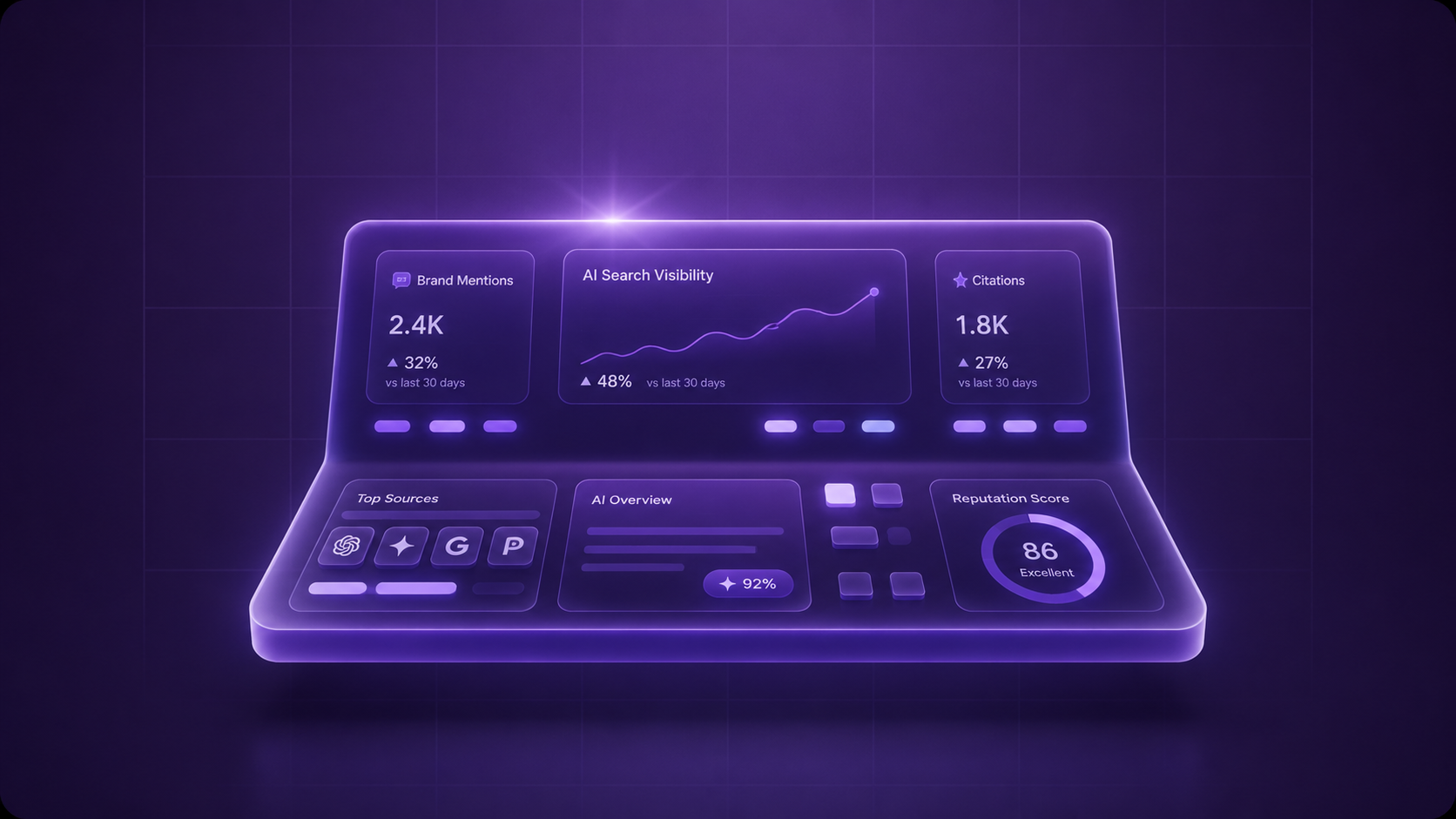
This is the measurement problem that Geckocheck was built to address. The platform tracks how your brand appears in AI-generated outputs across the major large language models and AI search surfaces. It surfaces the queries where you are included, the queries where competitors are being selected instead of you, and the content signals that are driving those outcomes.
What Geckocheck Makes Visible
Which queries your brand appears in across AI agent outputs
Which queries surface competitors where you should be present
What content and data attributes are influencing agent inclusion decisions
How your AI visibility has changed over time as you make content improvements
The information Geckocheck surfaces does not replace standard analytics. It fills the gap that standard analytics cannot reach: the evaluation that happens before a human ever arrives on your site.
For how GEO connects to the full commercial strategy, see Get Found, Get Recommended, Get Bought: A GEO Guide for Commerce Brands and Agentic Commerce Is Here. Is Your Brand Ready? for the broader context.
SOURCES
1. Gartner, Agentic AI in Enterprise Software Forecast (October 2024)