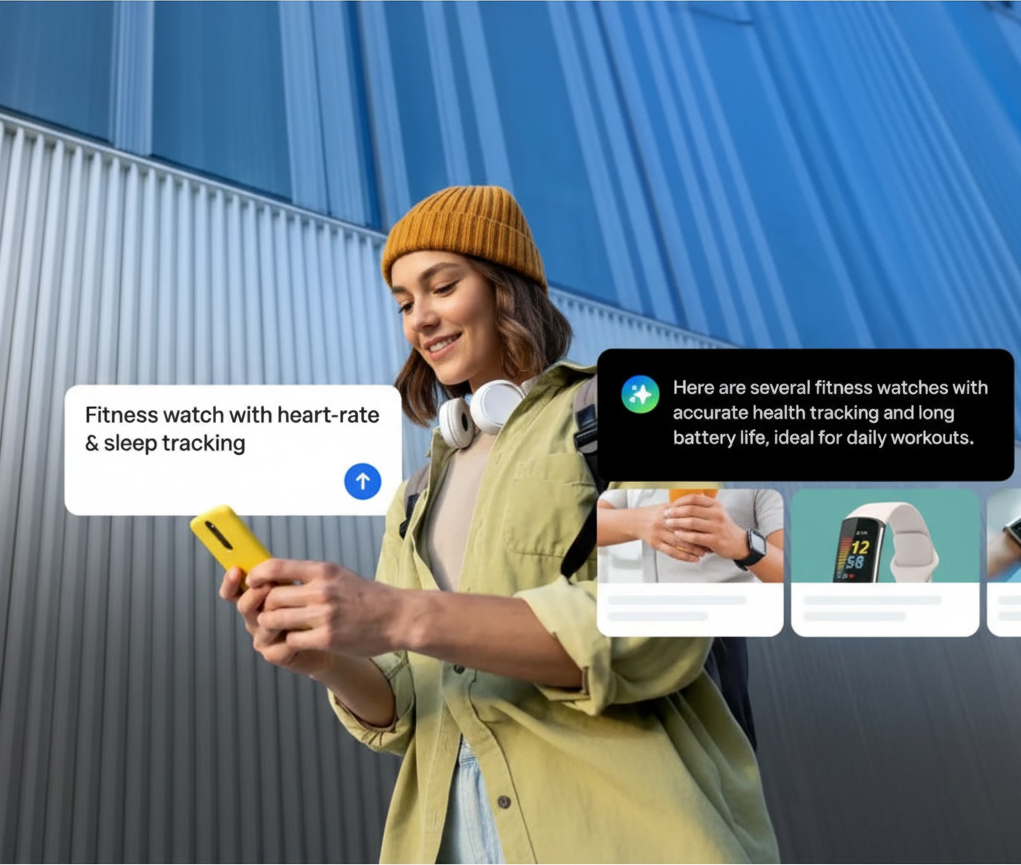
Most brands have already accepted that AI is changing how people search. Fewer have accepted what that actually means for their products.
It means the shift to agentic commerce isn't just a channel question. It's a data question. AI agents don't browse your product page. They query structured sources, pull specs, cross-reference availability, and generate a recommendation in seconds. And most product pages aren't built for that process.
The practice of fixing that has a name: shopping visibility optimization. This is the playbook.
The visibility gap nobody's talking about
Most brands are invisible to AI agents right now. Not because their products are bad. Because their data isn't built for the way AI agents search, evaluate, and recommend.
The traditional discovery funnel (run a search, land on a product page, browse, decide) is being compressed. AI agents now handle the full trip from finding a product to buying it, no human hand-holding required. That's not a forecast. That's the infrastructure OpenAI, Google, and others have already built.
The visibility gap is the distance between where your brand appears in a human-browsing world and where it shows up in an AI-agent world. For most brands, that gap is wider than they think.
The good news: it's a data problem, not a creative one. And data problems are fixable.
OPPORTUNITY FOR RETAILERS
Brands that structure their product data for AI discovery now are building the same kind of durable advantage that clean Amazon listings created a decade ago. The window is open. The question is who moves first.
What Shopping Visibility Optimization actually is
Shopping visibility optimization is the practice of structuring your product data so AI agents can find it, parse it, and recommend it confidently. It's not a replacement for SEO or a rebrand of it. It's the product-level execution layer that makes GEO real.
Where GEO (Generative Engine Optimization) is your brand's strategy for showing up across AI-driven search, shopping visibility optimization is how you deliver on that strategy at the SKU level. It's the difference between knowing you need to be visible and actually making your products visible.
It covers four things:
Structured data
Schema markup, labeled specs, identifiers that AI systems can parse without guesswork.
Cross-platform consistency
The same product data everywhere your brand appears: your site, Amazon, retail partners.
AI-readable attributes
Complete, organized product specs that answer the nuanced queries AI agents receive.
Real-time accuracy
Pricing, availability, and inventory that reflects reality, not what was true last month.
The infrastructure is already live
The biggest platforms have already made their bets. OpenAI launched its Agentic Commerce Protocol with Stripe, enabling purchases directly inside ChatGPT. Google has its Agent Payments Protocol. Shopify is building agent-native infrastructure. The commerce layer is being rebuilt around AI, and the brands that structure their product data for it now are the ones that will show up in it.
The window for getting ahead of this is open. It won't stay that way.
From product page to AI recommendation: what the journey actually looks like
Take a specific query: "I need a yoga mat thick enough for bad knees, non-slip, easy to clean, under $80." An AI agent receiving that question doesn't open your website or read your brand story. It pulls structured specs, cross-references price and availability, and returns a recommendation based entirely on how well each product's data matches the intent.
The product that wins isn't the one with the best lifestyle photography. It's the one with:
A thickness spec in a labeled, parseable field
"Non-slip" or equivalent surface material identified explicitly
Material listed with care instructions that confirm "easy to clean"
Price accurate and current
Availability confirmed across the surfaces the agent is querying
If any of those data points are missing, unstructured, or inconsistent, the agent moves on. Your page never enters the conversation.
This is what shopping visibility optimization fixes. It's not about getting more traffic. It's about getting into the conversation in the first place.
The four pillars of shopping visibility optimization
Pillar 1: Structured data
Schema markup via Schema.org is the foundation. It gives AI systems an explicit map of your product: name, brand, description, price, availability, identifiers, review ratings. All tagged clearly, not left to inference.
Without it, an agent is guessing. With it, your product becomes machine-readable in the truest sense.
Pillar 2: Cross-platform consistency
An agent querying your product might hit your direct site, your Amazon listing, and three retail partners in a single pass. If those sources return different product names, different specs, different prices, the agent treats that as a reliability signal.
Inconsistency means uncertainty. Uncertain products don't get recommended. Standardized names, identical core specs, synchronized pricing, and consistent identifiers across every channel you sell on. That's the baseline.
Pillar 3: AI-readable attributes
This is where most brands discover their biggest gap. AI agents handle nuanced, context-rich queries. "Best supplement for energy that doesn't cause jitters." "Running shoes for wide feet, road-ready, under $120."
Answering those queries requires granular, labeled data. Size range. Sole material. Heel-to-toe drop. Ingredient breakdown. Not buried in paragraph copy. Not embedded in an image. In a clean, structured attribute field.
The more complete your attribute coverage, the more queries your product can answer confidently.
Pillar 4: Real-time accuracy
Static product data was fine when humans browsed at human speed. Agents query at scale and expect current information. Price changes, out-of-stock variants, discontinued SKUs: if your structured data doesn't reflect reality, agents will either skip your product or surface it incorrectly.
Neither outcome is good.
How generative engine optimization and shopping visibility optimization work together
GEO is your brand's strategy for AI-era discovery. Shopping visibility optimization is how you execute that strategy at the product level.
Think of GEO as the frame. Shopping visibility optimization fills it.
GEO shapes how your brand appears in AI-generated answers, knowledge panels, and conversational search responses. It covers brand authority signals, content structure, and how AI systems understand your category positioning. Shopping visibility optimization handles the SKU-level execution: the specific, structured, accurate product data that turns a GEO strategy into actual recommendations.
You need both. GEO without shopping visibility optimization is brand awareness with no path to the recommendation. Shopping visibility optimization without GEO is product data optimization that's missing the strategic layer.
For ecommerce brands, shopping visibility optimization is often the faster starting point. It's concrete, measurable, and the results are visible quickly. Getting your top 20 SKUs AI-readable has a faster payback than a full GEO content strategy.
How AI agents score your products
AI agents aren't arbitrary. They're evaluating your product data against a query. Here's what they're actually checking:
Does this product match the stated intent? Specs need to be explicit enough to confirm relevance.
Is the data consistent across sources? Discrepancies signal unreliability.
How complete is the attribute coverage? Sparse data means fewer queries answered, fewer recommendations made.
Are identifiers present? GTINs, MPNs, and ISBNs let agents cross-reference your product across multiple sources with confidence.
Is the information current? Stale pricing or unavailable variants get flagged or skipped.
HOW CHATGPT RANKS PRODUCTS
When multiple merchants carry the same product, ChatGPT considers factors including availability, price, quality, whether a merchant is the primary seller, and checkout integration. Product results are organic and unsponsored, ranked on relevance, not paid placement. Source: openai.com/index/buy-it-in-chatgpt
How to build your shopping visibility optimization strategy in 30 days
You don't need a full platform overhaul to get started. You need a focused sprint on your highest-value products.
Week 1: Audit
If you've already run an AI readability audit on your product pages, use Week 1 to go deeper. If you haven't, start here:
Pull your product feed and check attribute fill rates across your top 50 SKUs.
Search your product name across your direct site, Amazon, and two retail partners. List every discrepancy.
Query ChatGPT or Perplexity with your key product specs. Note where your brand surfaces and where it doesn't.
Week 2: Prioritize and fix
Identify your 10–20 highest-value SKUs. These get fixed first.
Fill attribute gaps: add dimensions, materials, compatibility specs. Anything missing from labeled fields.
Add or validate GTINs and MPNs across every listing.
Week 3: Sync and structure
Standardize product names and naming conventions across all channels.
Synchronize pricing and availability so every source reflects the same reality.
Implement Schema.org product markup if it isn't already in place.
Week 4: Monitor and expand
Re-run the agent test from Week 1. Measure the difference.
Expand the fix to your next tier of SKUs.
Set up monitoring for pricing, availability, and spec consistency across platforms.
What winning looks like now
Winning in AI-driven commerce doesn't look like dominating a category page. It looks like being the product an agent surfaces confidently. Your data is complete, consistent, and built for the way AI agents evaluate options.
The brands building that advantage now are doing unglamorous work. Filling attribute fields. Syncing feeds. Standardizing naming conventions. It's not the work that gets talked about at conferences. It's the work that gets recommended to 700 million ChatGPT users.
The window is open. The question is simple: does your product data make the shortlist?
GECKOCHECK CAN HELP
Geckocheck audits your product data the way AI agents read it, surfacing gaps in attribute coverage, cross-platform inconsistencies, and schema issues before they cost you recommendations. See where your brand stands today.