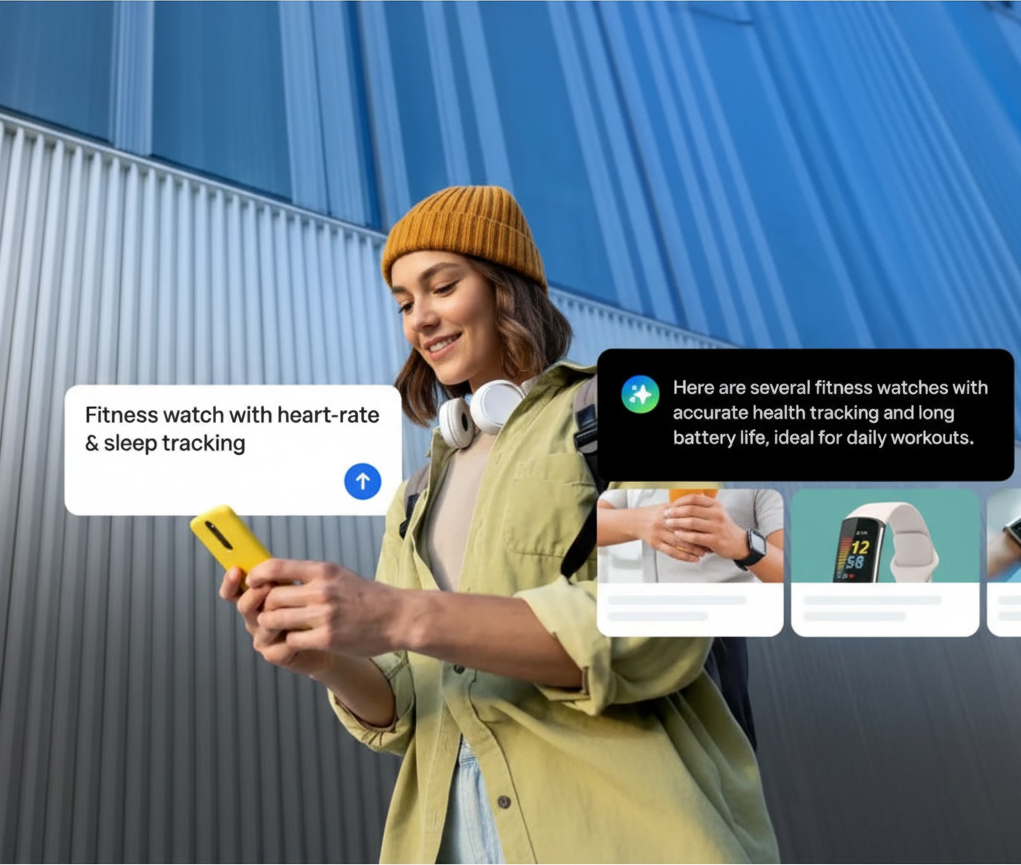
AI agents are already shopping, comparing, and recommending. Here's what's changing and what you need to do about it.
What is agentic commerce?
Picture this. You need running shoes before Friday. You tell your phone what you want and your budget. Then you put it down.
By the time you pick it back up, the shoes are ordered. The AI found them, compared prices, checked your sizing history, read the reviews, and placed the order. You didn't click a single thing.
That's the agentic commerce definition in action. It's what happens when AI stops answering questions and starts completing tasks on your behalf.
A search engine retrieves. A chatbot responds. An agent acts. It makes decisions, executes steps, and in many cases completes a purchase without a human in the loop.
Agentic commerce isn't a chatbot with a shopping cart. It's AI with a job to do and the autonomy to finish it.
For shoppers, this is a dream. For brands, it's a wake-up call. The signals that used to drive purchases, your homepage hero, your retargeting ad, your carefully crafted product page, don't reach an AI agent. What reaches an agent is your data, your reviews, and how consistently your brand appears across the surfaces AI systems use to make decisions.
If that information is incomplete or hard for a machine to read, you don't get a second chance. You just get skipped.
The numbers are already here
This isn't a prediction. It's happening now.
Morgan Stanley estimates that agentic shoppers could capture 10% to 20% of the US online retail market. That's not a niche segment. That's a fundamental rewrite of how purchase decisions get made.
"Agentic commerce doesn't care about your brand story. It cares about your brand data. If agents can't read you, they can't recommend you."
The agentic commerce protocol: how this actually works
McKinsey puts the global opportunity at $3 trillion to $5 trillion. The biggest companies in the world have seen the same number and they're moving fast. OpenAI launched an Agentic Commerce Protocol with Stripe, letting users complete purchases inside ChatGPT. Google launched its Agent Payments Protocol, backed by Mastercard, PayPal, and American Express. Shopify is building infrastructure for agents to shop across merchants. Visa is piloting agent transactions with Anthropic, Microsoft, and OpenAI.
What this means for your brand is simple. Agents evaluate based on what they can read and verify. Structured product data. Accurate specs. Consistent information across every platform. Strong, detailed reviews. If any of that is ambiguous or inconsistent, the agent moves on. It doesn't give you the benefit of the doubt. If your product data is messy, agents won't recommend you. They'll recommend whoever got their data right.
This is where Geckocheck comes in. We track where your brand appears across AI-powered search surfaces and where it doesn't. That visibility is the starting point for everything.
What intelligent commerce means for your team
AI e-commerce isn't just changing how shoppers behave. It's changing what your merchandising team can do.
Agents can monitor competitor pricing in real time, surface which of your products are getting recommended and which are being ignored, and audit product content at scale to flag gaps that are costing you visibility.
The teams winning right now treat their product catalog like a living document. Continuously updated. Structured for both humans and machines. A product description written for a human scanner is not the same as structured data written for an AI evaluator. Both matter now.
The risk most brands haven't thought about
Roughly 23% of Americans already made a purchase via AI in the past month. That's not early adopters. That's a mainstream behaviour shift happening right now, quietly, without most brands noticing.
In traditional ecommerce, you knew when you lost a sale. The cart was abandoned. The ad didn't convert.
In AI e-commerce, an agent might evaluate your product, find your data incomplete, and move on without you ever knowing it happened. No notification. No bounce rate. Just a lost sale you can't see.
This is the real risk of agentic commerce: being invisibly excluded.
Your product data is now a front-line sales asset. Accurate specs across every platform. Up-to-date pricing. A review profile agents can trust. And visibility into which AI surfaces are and aren't recommending you. That last part is exactly what Geckocheck is built for.
What you do next
The shift toward AI commerce is already underway. The best product used to win because the best marketer told the best story. In agentic commerce, the best product wins because the agent can see it, read it, trust it, and act on it.
Get your product data clean. Build reviews that are verified and detailed. Track your GEO visibility. And make sure you know where agents are finding you and where they're not.