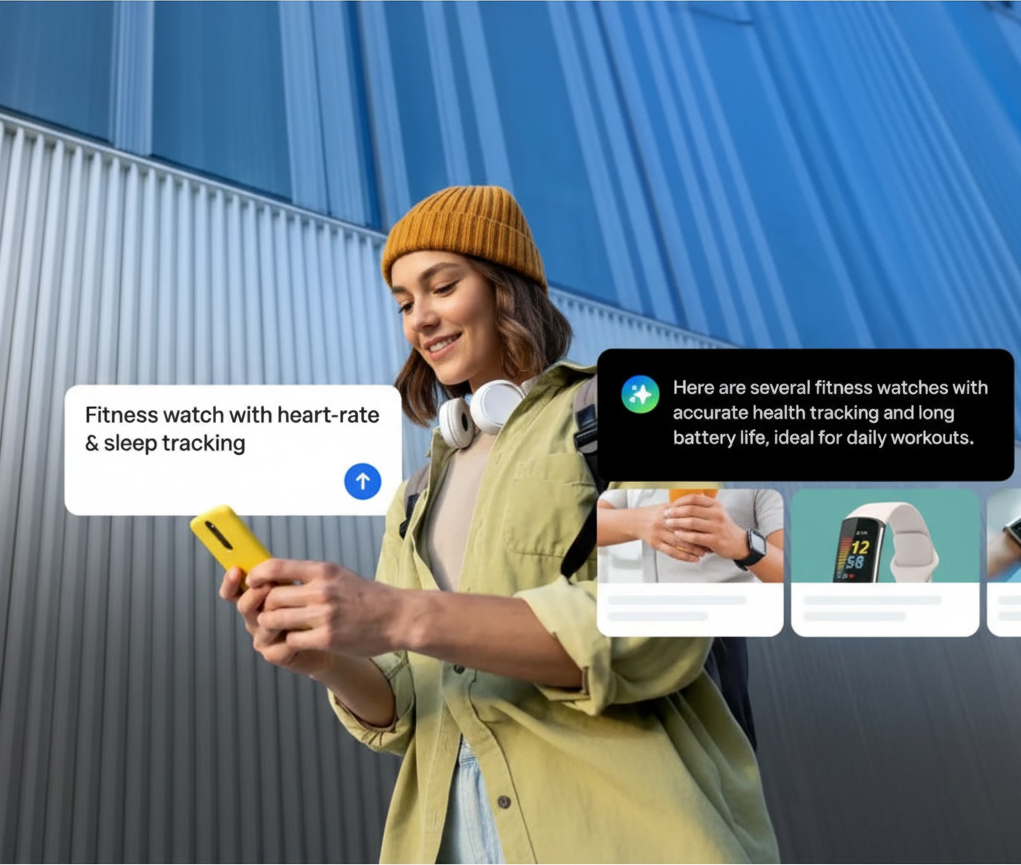
You spent months getting your product pages right. The photography is sharp. The copy is punchy. The layout guides shoppers exactly where you want them to go.
AI agents have almost no idea what to do with any of it.
This isn’t a knock on your creative team. It’s a structural problem, one that’s becoming more expensive to ignore. Eight in ten online retailers already use AI in some form[1], which means the baseline has shifted. Basic AI adoption is no longer a competitive edge. The edge now belongs to brands whose products are actually visible and readable to AI agents at the moment of discovery.
If you haven’t read our previous piece yet, start here: Agentic commerce is here. Is your brand ready?
AI agents aren’t browsers. They don’t scroll. They don’t admire. They parse, extract, and decide in milliseconds. And if your product page isn’t built for that process, your brand doesn’t make the shortlist.
Here’s what’s actually happening when an agent lands on your page, and what you can do about it.
1. What AI agents actually see when they land on your product page
Picture a shopper asking ChatGPT to recommend the best carry-on luggage under $300. The agent doesn’t open fifteen tabs and compare them the way a human would. It queries structured data sources, pulls product attributes, cross-references pricing and availability, and generates a recommendation. Often without rendering a single product page in the traditional sense.
This is AI shopping in practice: AI agents that analyze intent, evaluate options, and surface relevant products based on context[2]. And unlike a human browser, these systems have no patience for information that isn’t clearly structured.
When agents do access your page directly, they’re not reading it. They’re scanning for signals that AI agents can actually parse: structured data markup, product schema, clean attribute fields, consistent naming conventions. The visual hierarchy you’ve carefully designed is largely invisible to them.
What they’re actually looking for:
Product name that is exact, consistent, and unambiguous
SKU and GTIN identifiers
Price and availability in real time
Structured specifications including dimensions, materials, weight, and compatibility
Review signals in a parseable format
Category taxonomy that matches how AI systems organize products
If those elements aren’t present, structured, and accurate, the agent moves on. Your beautifully designed page never enters the conversation.
Geckocheck can help: See how Geckocheck reads your pages the way AI does
2. Why great photography and brand copy don’t help you get recommended
Brand storytelling has driven ecommerce for years. A compelling origin story, aspirational lifestyle imagery, copy that makes someone feel something. These are real competitive advantages when a human is making a decision.
Agents don’t feel anything. They evaluate.
The problem isn’t that creative work doesn’t matter. It still matters enormously for conversion once a shopper arrives. The problem is that creative-heavy pages are often built at the expense of structured content that AI agents can parse. Long-form prose descriptions bury the specifications agents need. Image-heavy layouts return little usable data. Marketing language optimized for emotional resonance is the opposite of what an AI agent needs to make a confident recommendation.
Brands with messy, incomplete, or outdated product data simply don’t show up. The agent moves on without them.[2]. It doesn’t matter how good the creative looks if the structured data underneath it can’t be parsed.
In agentic commerce, the page that gets recommended isn’t necessarily the most beautiful one. It’s the most legible one to an AI agent.
3. The specs gap: what agents need and what most pages are missing
This is where most brands discover their biggest vulnerability.
Ask yourself: if an AI agent needed to answer “does this fit in an overhead bin on a European budget carrier,” could it find that answer on your product page? Not inferred from a lifestyle photo of someone boarding a plane. Actually find it, in a structured, unambiguous data field.
For most brands, the answer is no.
The specs gap is the difference between what your page displays and what an agent can actually extract. It shows up in three consistent ways:
Incomplete attribute coverage.
A shoe page might list size and color but nothing on width options, sole material, or heel height. A supplement page might name the main ingredient but have no structured nutritional breakdown. Agents making nuanced recommendations need nuanced data.
Unstructured presentation.
Specs buried in paragraph copy, listed inside image overlays, or split across tabs are effectively invisible to automated systems. If it’s not in a clean, labeled field, it might as well not exist
Missing identifiers.
GTINs, MPNs, and ISBNs are how AI systems cross-reference your product across sources. Google relies on structured data sources like Merchant Center feeds and approved integrations to surface products inside AI-powered shopping experiences[2]. Without these identifiers, an agent can’t confidently match your listing to the same item appearing on a retailer’s site, in a review database, or inside a comparison query.
The brands closing this gap aren’t spending more. They’re being more deliberate about what information exists on their pages and in what format.
4. Consistency across platforms: your site, retailers, and marketplaces
Here’s a scenario that’s more common than most brands realize.
An agent queries your product. It finds your direct site, your Amazon listing, your Target page, and three retail partners, all with slightly different product names, different specs, different prices, and different availability statuses. Some have your GTIN. Some don’t. The descriptions vary. The category taxonomy doesn’t match.
To a human shopper landing on one page, this is invisible. To an AI agent synthesizing across sources, it’s a red flag. Inconsistency signals unreliability. And unreliable products don’t get recommended.
This matters especially now that major AI platforms are actively building infrastructure for agentic commerce across a wide retail ecosystem. Google’s Universal Commerce Protocol, co-developed with Shopify, Walmart, Target, and others, requires that inventory, pricing, availability, and fulfillment details be consistent and accessible across every connected surface[2]. Brands that can’t meet that bar simply won’t participate.
Cross-platform consistency is one of the highest-leverage investments a brand can make right now. It’s not glamorous work. But in a world where agents are cross-referencing your product across every surface it appears on, a clean and consistent product identity is a genuine competitive edge.
That means:
Standardized product names and naming conventions across every channel
Identical core specs regardless of where the listing lives
Synchronized pricing and availability
The same identifiers appearing everywhere your product does
5. What agent-readable product content actually looks like in AI commerce
Concretely, what does it take to compete in AI commerce? Here’s what agents actually need to find, evaluate, and recommend your products.
Schema markup.
Product schema via Schema.org gives search engines and AI systems a structured map of your product’s key attributes. Name, brand, description, price, availability, review ratings, identifiers, all tagged explicitly, not left for an AI agent to infer from your layout.
Product feeds.
Structured data exports, the kind used for Google Shopping, Meta Catalogs, and retail partner integrations, are increasingly the input layer for agentic commerce platforms. Retailers that invest in ecommerce SEO and site optimization are already taking steps in this direction[2]. Brands with well-maintained, regularly updated feeds have a direct on-ramp to AI-driven discovery. Brands without them don’t.
Attribute completeness.
The more complete your structured attributes, the more queries your product can answer confidently. AI agents work best when they have access to detailed, organized product data[3]. This isn’t about adding more words to your description. It’s about ensuring every relevant data point exists in a labeled, consistent, field that AI agents can read and act on.
Real-time accuracy.
Static product pages were fine when humans were doing the browsing. Agents querying at scale expect current information. Price changes, stock updates, variant availability. If your structured data isn’t current, agents will either skip your product or recommend it incorrectly. Neither outcome is good.
6. How to audit your product pages for AI readability
You don’t need a full platform overhaul to understand where you stand. Start here.
See what the GeckoCheck AI shopping audit checks.
Check your feed completeness.
Pull your current product feed and look at attribute fill rates. What percentage of products have complete specs? Consistent naming? Most brands are surprised by how much is missing.
Cross-reference your listings.
Search your product name across your own site, Amazon, and two retail partners. Note every difference in name, price, specs, and description. That list of inconsistencies is your consistency gap.
Ask the agent yourself.
Query ChatGPT or Perplexity for a product in your category with your key specs. See what surfaces. See how your brand appears, or doesn’t. This is the most direct signal available right now.
7. What you do next
The shift toward agentic commerce isn’t waiting for brands to feel ready. The infrastructure is live. The agents are already making recommendations, with or without your input.
The good news: the gap between where most brands are and where they need to be is a data problem, not a creative one. AI agents now handle the full trip from finding a product to buying it, no human hand-holding required[3]. That means the window to get your data right and your products visible is right now, before that behavior becomes the default for the majority of shoppers.
PwC’s 2025 Future of Consumer Shopping Survey found that 62% of millennials expect to order more online over the next five years, and 46% plan to increase automated reordering through smart devices[4]. AI commerce isn’t a fringe behavior heading to the mainstream. It is the mainstream, arriving faster than most brands are prepared for.
Start with the audit. Find your biggest gaps: schema markup, attribute completeness, cross-platform consistency, feed hygiene. This is the foundation of generative engine optimization (GEO) for product pages, and it starts with knowing exactly where your data falls short. Prioritize your highest-value products first. The goal isn’t perfection across every SKU on day one. It’s getting your best products AI-readable before your competitors do.
The brands that moved early on structured data for Google Shopping built advantages that lasted a decade. The same window is open right now for AI-native discovery.
Your product page was built for humans. It’s time to make it work for agents too.
Sources
[1] Capital One Shopping Research. "AI in Ecommerce Statistics." capitaloneshopping.com. Accessed March 2026.
[2] Waskar, Manish. Thrive Agency. "How Agentic Shopping Is Changing Product Discovery and eCommerce." thriveagency.com. Accessed March 2026.
[3] Beard, Nicolette V. BigCommerce. "Ecommerce AI Agents: The Autonomous Technology Transforming Digital Retail." bigcommerce.com. Accessed March 2026.
[4] PwC. "From shelves to systems: Why the future of consumer goods will be unrecognizable." pwc.com. Accessed March 2026.