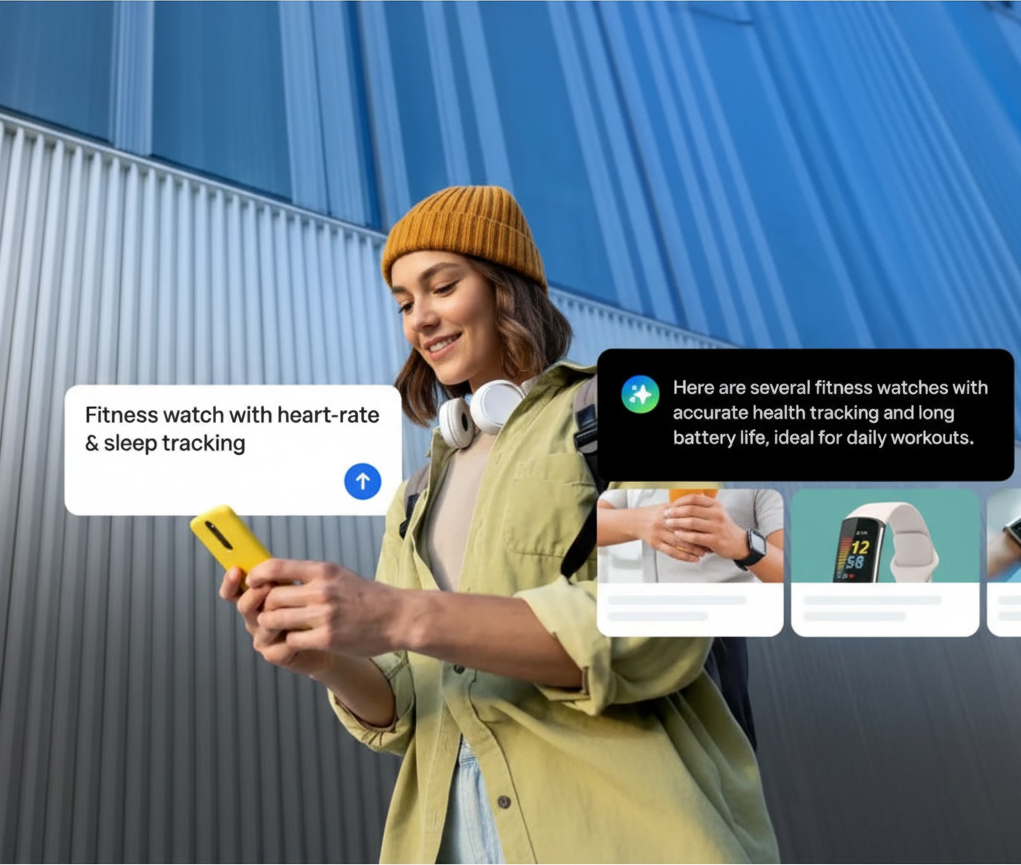
The way shoppers discover products is changing fast. Search bars still exist. Google still handles over 8 billion searches a day.[1] But increasingly, people are asking AI agents to find, compare, and recommend products on their behalf. The agent decides what gets surfaced. The agent decides what gets bought.
That volume is already shifting. Search Engine Land has reported a 20% drop in Google searches among US users.[2] Gartner predicts traditional search engine volume will fall by 25% as AI-powered alternatives mature.[3] The channel isn't disappearing. But the center of gravity is moving.
If your brand isn't optimized for how AI agents evaluate and recommend products, you're not in the running. That's what Generative Engine Optimization (GEO) is about. And for commerce brands, it's already mission-critical.
This guide walks you through what GEO means for commerce, how it works, and what you can do about it now.
1. What Is Generative Engine Optimization for Commerce?
Generative Engine Optimization is the practice of making your brand, products, and content discoverable and recommendable by AI-powered systems. For commerce brands, this means ensuring that when an AI agent is asked to help someone shop, your products come up and get recommended.
GEO isn't a single tactic. It's a strategic framework that spans your content, your product data, your brand authority, and how all of that gets structured for AI consumption. Unlike traditional SEO, which targets how a page ranks in link-based results, GEO is about earning a place inside the answer itself.
It's also distinct from Answer Engine Optimization (AEO), which focuses on securing specific featured snippets. GEO is broader: it's about becoming a trusted, cited source across the full range of complex queries an AI agent might handle on behalf of a shopper.
Think of GEO as the discipline of earning trust with AI agents the same way you've historically earned trust with search engines. The mechanics are different. The stakes are just as high.
2. Key Differences Between GEO and Traditional SEO in an Agentic Commerce World
Traditional SEO was built around one core behavior: a human typing a query into a search box and clicking a result. GEO operates in a different environment entirely.
With AI agents, there's no click. The agent reads, evaluates, and responds. It synthesizes information across multiple sources and delivers a recommendation directly. Your product page doesn't need to rank first. It needs to be readable, credible, and complete enough for an AI agent to confidently recommend it.
Intent is also interpreted differently. A user asking "What are the best running shoes for flat feet?" isn't just searching for keywords. They're asking for a recommendation. A pure SEO approach targets the phrase. GEO targets the underlying need and the context behind it, which is what allows AI agents to deliver genuinely useful answers rather than a list of links.
A few of the most important differences:
Intent interpretation: SEO targets keywords. GEO targets the full context of a user's need, as interpreted by an AI agent.
Content format: SEO rewards content built for humans skimming a page. GEO rewards content structured for AI parsing: clear attributes, precise language, consistent data.
Authority signals: SEO leans heavily on backlinks. GEO draws on brand mentions, review sentiment, factual accuracy, and cross-platform consistency. These are the signals that generative engines use to determine whether a source is trustworthy.
The decision layer: In SEO, the human decides what to click. In GEO, the AI agent decides what to recommend. You need to earn that recommendation.
SEO and GEO aren't competitors. They're complementary. Strong SEO foundations make GEO execution easier. But GEO requires a separate strategy and separate execution on top of what your SEO team already does.
3. How AI Agents Discover, Evaluate, and Recommend Products
Understanding how AI agents actually work is the foundation of any GEO strategy.
Discovery: AI agents pull from a wide range of sources: product feeds, brand websites, review platforms, structured data, and publisher content. They don't browse the way humans do. They parse and extract. If your product data is inconsistent across these sources, agents won't be able to build a reliable picture of your brand.
Evaluation: Once an agent finds your products, it evaluates them against the user's need. It looks at attributes, specifications, reviews, price, availability, and how well the product description matches the query. Vague descriptions and missing specs are a direct liability here. This is where E-E-A-T (Experience, Expertise, Authoritativeness, Trustworthiness) matters. Generative engines prioritize content that demonstrates genuine familiarity with the subject matter, whether that's a product specification or a buying guide. Confident, factually correct content is more likely to be selected.
Recommendation: The agent doesn't list ten results and let the user choose. It recommends. That means your product needs to be the clearest, most credible answer to the user's need. Accuracy, specificity, and consistency across platforms all feed into whether an AI agent recommends you.
This is the loop your GEO strategy needs to support. Every element of the framework below connects back to it.
4. Why GEO Is Mission-Critical for Commerce Brands
Agentic commerce is not a future trend. It's arriving now. Consumers are already using AI assistants to research purchases, compare products, and get recommendations. One in three US shoppers used generative AI tools to research unfamiliar products in the past year. Over half of AI Mode users now rely on it regularly.[4]
The brands that are optimized for AI recommendation capture that upside. The ones that aren't? They go unmentioned. Not penalized. Just invisible.
There's a compounding effect too. AI agents learn from the data they encounter. Brands that show up consistently with clean, accurate, well-structured product information get recommended more. That visibility generates more data signals, which generates more recommendations. Early movers in GEO are building a structural advantage that gets harder to close over time.
We covered the macro shift in Agentic Commerce Is Here. Is Your Brand Ready?. The short version: the channel is changing fast, and the window to build GEO infrastructure before it becomes table stakes is closing.
5. The GEO Framework for Commerce Brands
GEO for commerce operates across four interconnected layers:
Brand authority: How consistently and credibly your brand is represented across the web. This includes mentions, reviews, press coverage, and social proof. AI agents draw on all of it. Strong entity signals, including a well-defined organization schema with accurate social profiles and customer reviews, are foundational here.
Content infrastructure: The educational, editorial, and product content on your owned channels. This content teaches AI agents what your brand is about, what you sell, and who you sell to. Content that's current, clearly structured, and written for real user intent is more likely to be cited. Keeping informational content up to date and reinforcing it with authoritative original material matters more than volume.
Structured data and technical foundations: Schema markup, product feeds, metadata, and API accessibility. This is the infrastructure layer that makes your brand legible to AI systems at scale. Product, Offer, AggregateRating, and FAQPage schema types are the most relevant starting points for commerce brands.
Product-level optimization: The quality, completeness, and accuracy of individual product listings. This is where Shopping Visibility Optimization (SVO) lives.
Each layer reinforces the others. A strong brand reputation makes your product listings more credible. Well-structured product data makes your content easier to parse. Technical foundations make everything accessible. GEO works when all four layers are working together.
6. Where Shopping Visibility Optimization Fits Inside GEO
Shopping Visibility Optimization is the product execution layer of your GEO strategy. We introduced the concept in Your Product Page Was Built for Humans. AI Agents Can't Read It.. The core idea: your product pages were built for humans. AI agents can't read them the same way.
While GEO operates at the brand and category level, Shopping Visibility Optimization operates at the SKU level. It's the practice of making every individual product listing readable, evaluable, and recommendable by AI agents. That means:
Complete and accurate product attributes
Descriptions written for clarity, not just engagement
Structured data that connects your listing to how AI agents interpret product categories
Current pricing, availability, and shipping information. AI agents surface real-time buying context. Stale data breaks the recommendation.
Consistent information across every channel where your product appears
Without Shopping Visibility Optimization, your GEO strategy has a gap at the most critical moment: when an agent is evaluating whether to recommend a specific product. Brand authority and content infrastructure get you considered. Shopping Visibility Optimization is what gets you chosen.
7. Shopping Visibility Optimization as the Product Layer of Your GEO Strategy
Here's a useful way to think about the relationship: GEO builds the runway. Shopping Visibility Optimization lands the plane.
Your GEO strategy ensures AI agents know who you are, trust your brand, and have the infrastructure to access your catalog. Shopping Visibility Optimization ensures that when an agent reaches a specific product, it finds everything it needs to recommend it with confidence.
In practice, Shopping Visibility Optimization work sits within the fourth layer of the GEO framework and feeds back up into the others:
Better product data improves structured data quality, which strengthens your technical foundations.
Accurate product descriptions contribute to the broader content infrastructure AI agents use to understand your brand.
Positive agent recommendations, driven by well-optimized listings, generate more brand mentions and authority signals over time.
Shopping Visibility Optimization isn't a standalone tactic you bolt on. It's an integral part of your GEO architecture, operating at the product level while the rest of the framework operates at the brand level.
8. Measuring GEO and Shopping Visibility Optimization Success in AI Commerce
Measurement in GEO is still evolving, but the early signals are clear. GEO doesn't replace traditional SEO metrics. It adds a new layer of them. Here's what to track:
AI referral traffic: How much of your site traffic is arriving from AI-powered channels like Google AI Overviews, Perplexity, or ChatGPT? This is growing fast and worth tracking separately from organic.
Brand mention frequency: How often does your brand appear in AI-generated responses and recommendations? Share of source is the emerging metric here: how often your domain is cited versus competitors for high-priority queries.
Product listing completeness score: What percentage of your catalog meets the data quality threshold required for AI recommendation? This is a direct Shopping Visibility Optimization metric.
Conversion rate from AI-originated sessions: Visitors arriving via AI referral tend to have high intent. Track how they convert compared to other channels.
Structured data coverage: What share of your catalog has complete schema markup? This is a foundational GEO health metric that's easy to audit and act on.
Since many AI tools don't provide detailed click data, indirect signals matter too: scroll depth on AI-referenced content, assisted conversions, and changes in branded search volume can all indicate GEO traction. Build toward these metrics. The brands that instrument GEO measurement now will have a learning advantage as the channel matures.
9. Governance, Budgeting, and Cross-Team Alignment
GEO touches multiple teams. Content, product, engineering, and marketing all have a role. Without clear ownership, it fragments.
A few principles that work in practice:
Assign a GEO lead: Someone needs to own the overall framework and coordinate across functions. This doesn't need to be a new hire. It needs to be a named responsibility.
Separate Shopping Visibility Optimization from general content work: Product-level optimization is distinct from brand content strategy. It needs dedicated time, tooling, and budget.
Build GEO into your product catalog workflow: Retroactively fixing product listings is hard. The better play is making AI-readiness part of how new products get listed from the start.
Budget for infrastructure, not just content: GEO requires technical investment. Schema markup, feed management, and structured data tooling aren't optional layers. They're core to the strategy.
Cross-team alignment doesn't happen by accident. Build a shared GEO scorecard, review it quarterly, and make sure every stakeholder understands what they own.
10. Frequently Asked Questions
Is GEO only relevant for large brands?
No. AI agents don't inherently favor big brands. They favor complete, accurate, well-structured information. A smaller brand with excellent product data and strong review signals can outcompete a larger brand with poor GEO execution.
How is GEO different from what my SEO team already does?
SEO optimizes for search engine rankings. GEO optimizes for AI agent recommendations. The audiences are different, the evaluation criteria are different, and the technical execution overlaps only partially. Your SEO team's work is a foundation, but GEO requires additional strategy and tooling on top of it.
Where do I start if I'm behind?
Start with your product catalog. Audit your highest-volume SKUs for data completeness and accuracy. Fix the gaps. Add structured data where it's missing. That's the fastest path to improving your AI recommendability at the product level, and it feeds directly into every other layer of your GEO strategy.
Do I need new technology to do GEO?
Some of GEO is executable with your existing stack: content improvements, schema markup, product data cleanup. For brands with large catalogs, dedicated GEO tooling makes this scalable. Platforms built specifically for AI commerce visibility, like Geckocheck, give you the infrastructure to operationalize GEO across your entire catalog.
11. Looking Ahead: The Future of GEO, Shopping Visibility Optimization, and Agentic Commerce
The trajectory is clear. AI-driven search is projected to grow from under 1% of US search ad revenue in 2025 to 14% by 2029.[4] That's a channel shift playing out in real time. PwC estimates AI will contribute $15.7 trillion to the global economy, with retail and consumer goods among the most affected sectors.[5] Agentic commerce is a major part of that shift.
What's less clear is how fast the window stays open. Every month, more brands invest in GEO. The standards AI agents apply to product data will rise as more catalog content gets optimized. The brands that build GEO infrastructure now are ahead of that curve. The ones that wait are chasing it.
Shopping Visibility Optimization will continue to evolve too. As AI agents become more sophisticated, the bar for what counts as a complete, credible product listing will rise. The goal today is to meet the current standard and build the systems that let you adapt as that standard changes.
The brands that win in agentic commerce won't be the ones with the biggest ad budgets. They'll be the ones AI agents trust most. That trust is built through GEO, and it starts with your product data.
Ready to build your GEO strategy?
Geckocheck helps commerce brands get found, evaluated, and recommended by AI agents. Start with your product catalog and build from there. See how Geckocheck works.
Sources
[1] Exploding Topics: Google Search Statistics
[2] Search Engine Land: US Google Search Decline
[3] Gartner: Search Engine Volume Prediction