Your board is asking why organic traffic is softening. Your agency is recommending more content. And somewhere upstream, a growing share of your customers are asking AI agents what to buy and never making it to your site at all. This guide is for CMOs who need to understand what generative engine optimization (GEO) actually means for commerce brands, and what to do about it before it becomes a crisis.
Your traffic looks fine. Your visibility might not be.
There's a version of this problem that doesn't show up in your dashboards. Sessions are stable. Rankings look reasonable. Your team is producing content. And yet something has shifted in how your customers actually find and decide what to buy.
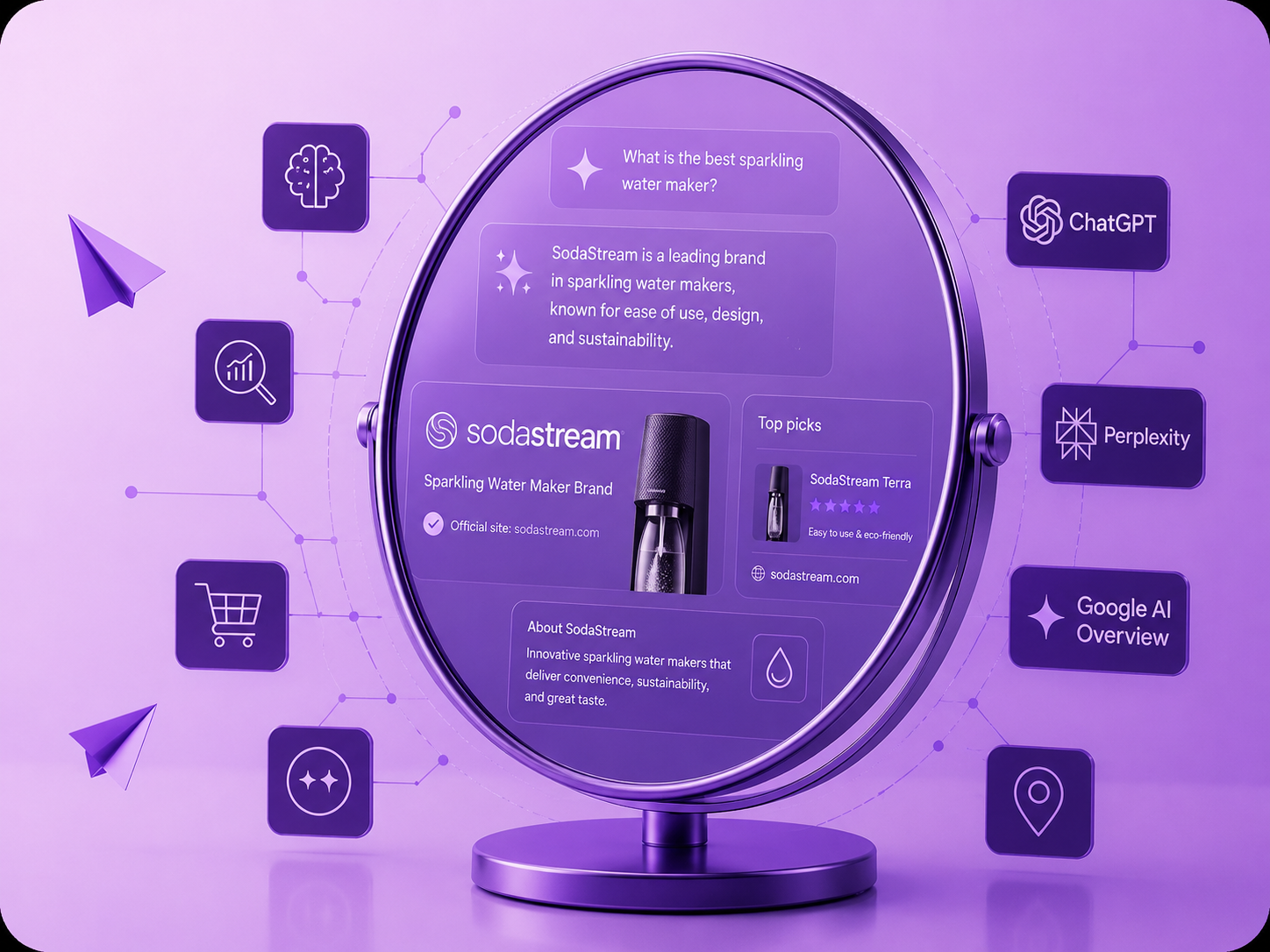
What's shifted is that a growing share of shopping journeys now start with a question to an AI agent, not a search query. The agent researches, compares, and shortlists before the shopper ever visits a product page. If your brand doesn't show up in that process, you don't drop in rankings. You simply don't exist in that shopper's decision.
The IAB's 2025 study on AI-guided shopping put a number to this: nearly 90% of shoppers say AI helps them discover products they wouldn't have found otherwise, and 64% had AI recommend a new brand during an active session. These aren't experimental users. This is mainstream behavior, and it's already reshaping which brands get considered and which don't.
The measurement gap nobody's talking about
When an AI agent evaluates your products and doesn't recommend them, nothing registers in your analytics. No impression. No bounce. No lost click. You have no idea it happened. That's the part of the problem that makes it easy to underestimate.
This is the operating environment GEO is built for. Not to replace your existing search strategy, but to address the layer above it: the AI evaluation stage that's increasingly deciding which brands get to compete at all.
Why the metrics your board cares about are no longer enough
Sessions, click-through rates, organic rankings. These metrics still tell you something real. But they're measuring a world where a human types a query, sees your link, and decides to click. That's a smaller share of the discovery process than it used to be.
When an AI agent recommends your product, the click often doesn't happen until the shopper has already made their decision. The IAB found that high-intent shoppers' visits to retailer sites nearly tripled after interacting with AI, and one in three clicked directly from an AI platform to a retailer. That traffic converts well. But it doesn't show up in your organic traffic report until after the AI has already done the work.
The CMOs who are getting ahead of this are measuring a different set of signals alongside their existing metrics:
Metric | What it tells you | Why it matters now |
|---|---|---|
AI referral traffic | Sessions arriving from ChatGPT, Perplexity, Google AI Overviews | Shows how much of your funnel already runs through AI-mediated channels |
Brand mention frequency | How often your brand appears in AI-generated responses for key queries | The emerging share-of-voice metric for AI outputs. Hard to track today; essential tomorrow. |
Listing completeness score | % of your catalog meeting AI-readiness thresholds | Direct readout of your shopping visibility optimization health |
Structured data coverage | % of catalog with complete schema markup | A foundational GEO health metric. Easy to audit, often in worse shape than teams expect. |
Conversion from AI sessions | How AI-referred visitors convert versus other channels | AI referral sessions typically carry higher intent. This metric makes the revenue case. |
Assisted conversions | Conversions where AI content touched the journey upstream | Captures revenue impact that standard last-click attribution misses entirely |
Most AI platforms don't yet provide granular click data, so indirect signals matter too. Watch for shifts in branded search volume, direct traffic patterns, and engagement depth on content that AI tools tend to cite. The CMOs building these measurement frameworks now will have a meaningful learning advantage as the channel matures.
How the AI-driven conversion funnel actually works
The AI-driven funnel doesn't eliminate the stages of awareness, consideration, and purchase. It moves the weight of each stage. By the time a shopper arrives on your site from an AI referral, the consideration stage is often complete. The agent has already done the comparison work.
That changes what that visitor needs from your site. They're not browsing. They're confirming. Conversion rates from AI-referred sessions reflect this, but reaching those visitors means winning upstream, at the evaluation stage that happens before your site is ever visited.
Where each stage of the funnel now sits
Discovery: The shopper asks a question. The AI agent pulls from product feeds, brand content, review platforms, and structured data to assemble a response. Brands that don't appear in those sources aren't part of the answer.
Learn how to explore the Customer Journey page in GeckoCheck.
Evaluation: The agent scores options against what the shopper actually needs. Vague descriptions, missing attributes, and inconsistent pricing across sources are disqualifiers at this stage, not just inconveniences.
Recommendation: The agent surfaces a product or a short list. This is where the sale is won or lost. Not on your PDP. Not in your email sequence. Here.
Site visit: The shopper arrives with purchase intent already formed. Your product page confirms the decision or raises doubt.
Review loop: Post-purchase reviews and sentiment feed back into the data AI agents draw on. Brands that earn strong reviews compound their AI visibility over time.
The critical implication for marketing leaders is that you can't optimize into this funnel from the bottom. The work that determines whether you're in the recommendation or not happens at the data and content layer, before the shopper ever sees your site. That's the domain of shopping visibility optimization: the product-level execution that determines whether an AI agent recommends your listing or skips it.
GEO, AEO, and SEO: how they fit together for a CMO
Most marketing teams right now are treating GEO, AEO, and SEO as variations of the same thing. They're not. Understanding where each one operates is what lets you allocate investment correctly and avoid the common mistake of assuming your existing search program covers the AI layer.
SEO | AEO | GEO | |
|---|---|---|---|
What it optimizes for | Search engine rankings | Featured answers and direct responses | AI agent trust and product recommendation |
Primary audience | Humans clicking search results | Answer engines responding to single queries | AI agents evaluating products on behalf of shoppers |
Key lever | Content, backlinks, technical site health | Concise Q&A content, structured markup | Product data completeness, schema, cross-platform consistency |
Where it shows up | Search results page | Featured snippets, AI Overviews | AI-generated recommendations and responses |
Time to impact | Weeks to months | Days to weeks for targeted content | Compounds over months as brand authority builds |
Who owns it | SEO and content teams | Content and SEO teams | Requires coordination: content, product, engineering |
AEO and GEO both matter, and a strong SEO foundation supports both. But conflating them leads to underinvestment in the infrastructure work that actually drives AI recommendation: product data quality, schema markup, and brand-level consistency that no content calendar can substitute for.
The practical question for a CMO is: do you have a named owner for the GEO layer? In most commerce organizations, this work currently falls into a gap between teams. SEO owns rankings. Content owns publishing. No one owns AI-readiness at the catalog level. That gap is where brands go unmentioned.
What actually gets a brand cited by AI: the content signals that matter
AI agents don't surface brands based on budget or brand awareness. They evaluate against a set of data quality and credibility signals. Getting those signals right is different from what most content strategies are currently built around.
The signals that drive AI recommendation
Data completeness: Every missing attribute is a reason for an agent to pass. Full product specs, accurate dimensions, compatibility notes, and up-to-date pricing aren't just good practice. They're minimum requirements for AI evaluation.
Cross-platform consistency: AI agents cross-reference your site against product feeds, marketplace listings, and review platforms. When the information doesn't match, they register the discrepancy as unreliability.
Content authority: Generative engines assess whether your brand demonstrates genuine expertise in your category. Educational content, original research, and expert-authored product context all contribute to how AI systems weigh your brand as a source.
Structured schema: Product, Offer, AggregateRating, and FAQPage schema give AI systems an unambiguous map of your catalog. Brands without schema force agents to infer, and inference introduces error.
Review quality: Substantive reviews carry more signal than star ratings. The depth and specificity of customer language about your products feeds directly into the trust indicators AI agents use.
The pattern that separates brands AI recommends from those it ignores
It's not reach. It's not a reputation in the traditional sense. It's structural. The brands that show up consistently in AI outputs have product information that is complete, consistent, and structured the same way everywhere it appears. That work isn't glamorous. Most commerce teams haven't done it yet.
How to build the GEO business case for your leadership team
GEO is a multi-team infrastructure investment. That means it needs a business case, and it needs framing that works with finance and executive leadership, not just marketing.
The challenge is that GEO operates on a different ROI model than the paid channels most leadership teams are used to evaluating. It compounds over time rather than producing immediate returns, and the metrics that prove it work are different from the metrics on the quarterly dashboard. Here's how to frame it.
Four arguments that land with finance and the C-suite
Frame it as channel protection, not new spend: AI-driven discovery is absorbing queries that previously went to organic search. GEO isn't incremental investment. It's the cost of maintaining visibility as the channel shifts. Framed this way, the question becomes: what's the cost of not doing it?
Lead with conversion quality: AI-referred traffic converts at higher rates because the agent has already qualified the shopper. Position this as a cost-per-acquisition improvement, not just a traffic play. Early data from AI referral sessions supports this argument concretely.
Show the compounding math: Structured data and brand authority signals accumulate over time and don't disappear when budgets get cut. GEO builds a durable asset. Paid media builds nothing when you stop spending. That distinction resonates with finance teams looking at long-term cost efficiency.
Quantify competitive exposure: If key competitors are investing in GEO and you're not, the gap in AI recommendation share grows every quarter. Run a simple competitive AI visibility audit to show where your brand currently appears versus competitors in AI outputs on your top queries. The visual is often the most persuasive part of the business case.
eMarketer reported a 752% year-over-year spike in AI referral traffic to ecommerce brands from platforms like ChatGPT and Perplexity. That trajectory makes the investment case less speculative and more straightforward: this is a present-day channel management decision, not a future bet.
The CMO's practical GEO roadmap: where to start and how to organize
The operational challenge with GEO is that it crosses team boundaries in ways that most commerce organizations aren't currently structured for. Content, product, and engineering all have to move together. Without clear ownership, the work fragments and stalls.
How to organize for GEO
Assign a named GEO lead: This is the most important first step. Someone needs to own the overall framework and coordinate across functions. It doesn't have to be a new hire. It does have to be a named responsibility with budget and access to data.
Build a shared GEO scorecard: Establish the six metrics from the measurement section of this guide, set baseline numbers, and review them quarterly alongside your existing marketing KPIs. What gets measured gets resourced.
Separate product data work from content work: Shopping visibility optimization at the catalog level is distinct from brand content strategy. It needs dedicated time, tooling, and budget. Treating it as a content task is why it doesn't get done.
Bake AI-readiness into your catalog workflow: Retroactively fixing product listings is expensive and slow. The better play is making data completeness and schema markup part of how new products get listed from the start.
Execution order for the first 90 days
Run a catalog completeness audit. Identify what percentage of your top SKUs by volume meet basic AI-readiness thresholds: complete attributes, accurate pricing, current availability, schema markup in place. That number is your baseline.
Audit structured data coverage across your top-performing products. Identify gaps and prioritize fixes by traffic and revenue weight.
Identify the content gaps where your brand lacks authoritative material on core category topics. These are the queries where AI agents currently cite your competitors instead of you.
Evaluate tooling. For brands with large catalogs, purpose-built GEO infrastructure matters. Geckocheck is built to operationalize shopping visibility optimization at catalog scale, rather than fixing it listing by listing.
The window to build GEO infrastructure before it becomes table stakes is closing. The standards AI agents apply to product data will rise as more catalog content gets optimized. The brands building now are ahead of that rising bar. The ones that wait are chasing it.
Sources
• IAB: When AI Guides the Shopping Journey (October 2025)
• eMarketer: AI is Rewriting the Start of the Shopping Journey (2025)
• eMarketer: AI Shopping Referrals and Retail Trends (2025)
• Geckocheck: Agentic Commerce Is Here. Is Your Brand Ready?
• Geckocheck: Your Product Page Was Built for Humans. AI Agents Can't Read It.